What are Refractometers?
A refractometer is a scientific instrument used to measure the refractive index of various materials, which indicates the extent to which light is bent when it passes through a sample. The refractive index, calculated using Snell’s Law, compares the speed of light in a vacuum with its speed in the material. This measurement is crucial in many fields such as physics, chemistry, biology, agriculture, and industrial fabrication, due to its role in determining the concentration of substances in solutions, identifying minerals, and assessing the purity of products.
Working Principle of Refractometers
The working principle of refractometers is based on the refraction of light, which occurs when light passes from one medium to another with a different refractive index. This change in speed and direction of light is described by Snell's Law, which states:

Where:
n1 = refractive index of the first medium (usually air)
n2 = refractive index of the second medium (the sample)
θ1 = angle of incidence (the angle between the incoming light and the normal to the interface)
θ2 = angle of refraction (the angle between the refracted light and the normal)
Steps in the Measurement Process
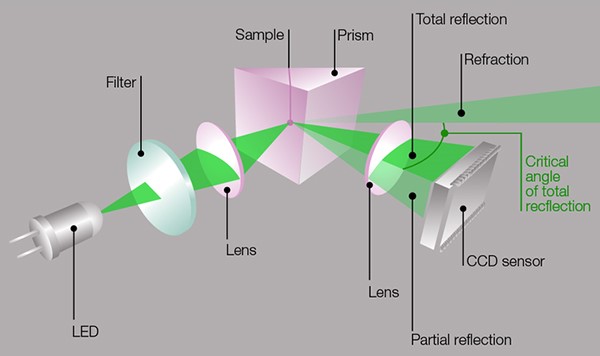
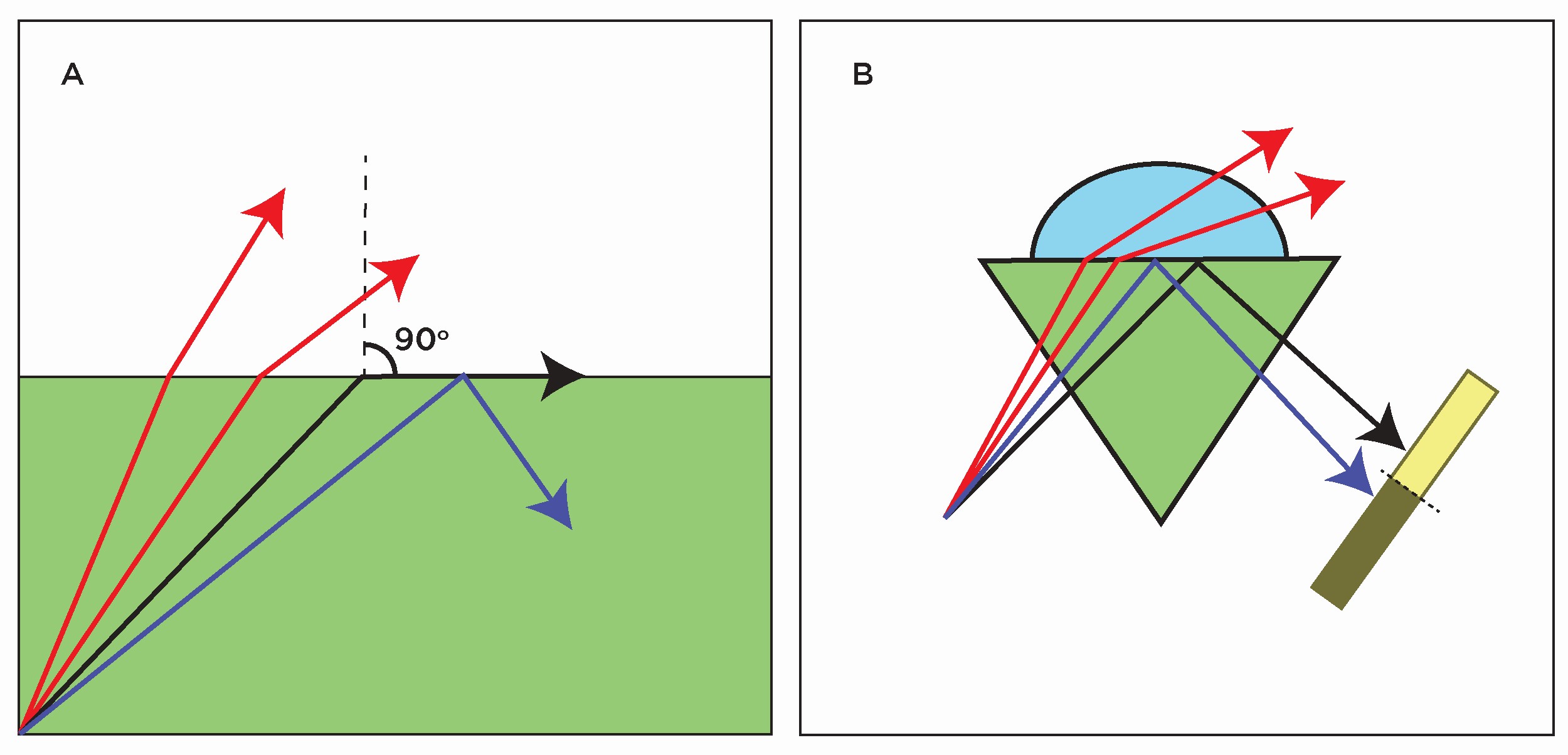
The refractometer uses a light source to illuminate the sample. The light is directed towards a prism or optical element where the sample is placed. The sample's refractive index is to be determined through the interaction of light with it. As light enters the prism, it is refracted at the boundary where the sample and prism meet. This bending of light creates an angle that depends on the refractive indices of both the sample and the prism. The refractive index of the sample can be derived from this angle.
In refractometers, the light enters the prism at an angle greater than the critical angle for the prism-sample interface. This leads to total internal reflection. The angle of the reflected light is measured, and from this angle, the refractive index of the sample can be calculated.
The refracted light is then detected either through an eyepiece (in analog refractometers) or using electronic sensors (in digital refractometers). The measurements are displayed on a scale or digital readout. Using the angles measured and Snell’s Law, the refractive index of the sample is calculated.
Components of a Refractometer
Refractometers come in different formats depending on their intended use, but they generally include the following key components:
Light Source: Provides the light that passes through or reflects off the sample. This can be natural light, LED, or a laser depending on the device’s precision requirements. Higher-end refractometers often use monochromatic light sources to improve accuracy.
Prism or Optical Element: A refractometer uses a prism or another optical element with a known refractive index to interact with the sample. In traditional models, the sample is placed directly on the prism, and light passing through the sample and prism interface is refracted. The refractive index of the sample is then calculated from the resulting light path changes.
Sample Holder: This is where the liquid or solid sample is placed. The sample holder must ensure precise positioning and often include mechanisms for temperature control, particularly in sensitive measurements.
Detector or Scale: A scale, detector, or sensor measures the angle of the refracted light, which is then used to calculate the refractive index. In modern refractometers, digital sensors are often used to display results instantly on a screen.
Temperature Control System: Since the refractive index can vary with temperature, precision refractometers often include temperature control mechanisms like Peltier elements or external temperature sensors to maintain a constant environment for accurate measurements.
Measurement Optics and Focusing Mechanism: These components guide and focus the light through the sample, ensuring accurate refraction. Focusing systems help achieve better resolution in high-precision devices.
Digital or Analog Display: The refractive index measurement is displayed on either a digital or analog scale. Digital handheld refractometers and benchtop devices usually display results directly, while some traditional models require reading from a graduated scale.
Types of Refractometers
Refractometers are categorized based on their design, application, and the type of sample they are meant to measure. Below is an expanded overview of the main types:
1. Handheld Refractometers
These are compact, portable devices that are often used in the field for measuring the refractive index of liquids. Handheld refractometers can be analog or digital, with the digital variants offering higher precision. They are commonly used in the food industry, such as in winemaking, beekeeping, and brewing, to measure sugar concentrations (Brix scale).
- Analog Handheld Refractometers: Simple devices where the user looks through an eyepiece to see the refractive index or concentration scale. They do not require a power source and are often used for quick checks.
- Digital Handheld Refractometers: These models use electronic sensors and display the refractive index digitally. They are more precise than analog versions and can store or transmit data, but they need a power source.
2. Abbe Refractometers
Named after the German physicist Ernst Abbe, these are commonly found in laboratories. The Abbe refractometer operates by using the principle of total internal reflection, where light is refracted at the critical angle in a sample placed between two prisms. The refractive index is determined by measuring the angle at which light exits the prism-sample interface.
Abbe refractometers are highly precise and are used in research labs, especially in chemistry and biology, to measure the refractive indices of liquids and transparent solids.
3. Inline Process Refractometers
Designed for continuous monitoring in industrial processes, inline refractometers are integrated into production systems. They provide real-time refractive index measurements to control quality and ensure consistency during manufacturing processes. Inline refractometers are used in industries such as food processing, petrochemicals, and pharmaceuticals.
Advantages: Real-time data, high measurement speed, and the ability to operate under harsh conditions like high temperatures and pressure.
4. Gemstone Refractometers
These are specialized refractometers used in gemology to measure the refractive index of gemstones. Gemstones are transparent minerals that can be identified by their refractive index, which is a material constant. The refractometer helps gemologists distinguish between different types of stones, such as rubies, sapphires, and diamonds.
- Polarization Filter: Since some stones are optically anisotropic, exhibiting birefringence, gemstone refractometers often include a polarization filter to differentiate between refractive indices for different light polarization planes.
5. Rayleigh Refractometers
Used primarily for measuring the refractive indices of gases, Rayleigh refractometers rely on the interference pattern created by light passing through a gas sample. They are typically used in scientific research and atmospheric studies to investigate gas compositions.
6. Fiber-Optic Refractometers
These refractometers employ fiber optics to probe changes in the refractive index of a surrounding medium. They are useful in applications where direct contact with the sample is challenging, such as in hazardous or remote environments.
Fiber Bragg Grating (FBG): A common feature in fiber-optic refractometers is the use of FBGs, which interact with the sample’s refractive index, causing a spectral shift that can be measured accurately.
7. Interferometric Refractometers
These use interferometry, a method based on measuring the phase change in light waves as they pass through different materials. Interferometric refractometers are extremely precise, often used to measure small changes in the refractive index due to environmental influences like temperature or pressure variations.
Rayleigh Interferometer: A specific type that measures changes in an interference pattern caused by the phase shifts in light, providing high-precision refractive index measurements.
8. Automatic Refractometers
These devices use advanced electronics and software for automatic measurements. They require minimal user interaction and are often used for high-throughput or automated industrial processes. Automatic refractometers can measure refractive indices with exceptional accuracy and often integrate temperature control, data logging, and communication interfaces for complex laboratory setups.
Flow Cells: Automatic refractometers often feature flow cells that allow continuous measurements of liquid samples without manual handling. These are essential for applications requiring constant monitoring, such as quality control in the beverage or pharmaceutical industries.
Applications of Refractometers
Refractometers play a vital role across various fields due to their ability to measure the refractive index, which can reveal the composition, concentration, and purity of materials.
These instruments are used in the optics industry to accurately measure the refractive index of optical materials. Since the refractive index is a critical parameter for optical design and performance, precise measurement is essential during material selection and quality evaluation.
In the food and beverage industry, refractometers are commonly used to measure sugar content in products such as fruit juices, honey, and wine. This application relies on the principle that sugar concentration has a strong influence on the refractive index compared to many other dissolved substances.
The same refractive index–based principle is applied in the pharmaceutical industry to determine the concentration of active ingredients in solutions. It is also used in certain fields to measure the salinity of seawater and to determine protein concentration in biological samples by correlating refractive index changes with concentration.
The refractometers are used to measure the density of petroleum products in the oil and gas industry. Changes in refractive index provide a means to assess and compare different petroleum compositions.
In geology, refractometers are applied for mineral identification. Since minerals can exhibit significantly different refractive indices even when they appear visually similar, refractometric measurements support accurate mineral classification.
Gophotonics has listed Refractometers from the leading companies. Use the parametric search tool to find products based on your requirements.

