41 Polarization Controllers
from
8 Manufacturers
41 Products
from
8 Manufacturers
Page 1 of 4
What is a Polarization Controller?
A polarization controller is an optical device that modifies and stabilizes the polarization state of light as it propagates through an optical system. In fiber-based environments, it enables the conversion of any input polarization into any desired output polarization by manipulating birefringence, ensuring stable signal performance in systems such as fiber interferometers, coherent communication links, quantum channels, and high-precision sensing setups.
A symbolic representation of a typical polarization controller is shown in the Figure.
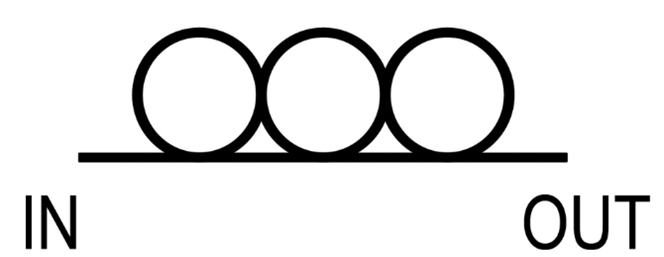
Fig: Symbol of a Polarization Controller
These devices are designed to continuously and accurately transform polarization states, such as converting linear to circular or elliptical polarization. By compensating for environmental fluctuations and fiber-induced changes, polarization controllers play a critical role in maintaining signal integrity, reducing interference, and optimizing overall system efficiency.
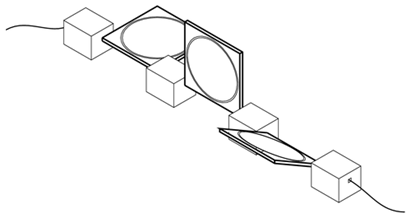
Fig: 3D diagram of an optical fiber polarization controller.
Working of a Polarization Controller
Polarization controllers operate by creating controlled birefringence within an optical fiber or bulk optical element. When light enters the device, it encounters regions where the refractive index differs along two orthogonal axes. This causes the light to split into fast and slow components and accumulate a phase difference as it propagates. By adjusting the induced birefringence, the phase relationship between these components can be precisely controlled, resulting in a new polarization state at the output.
Mechanical fiber controllers achieve this by bending or squeezing the fiber using paddles or stress-inducing mechanisms, which simulate the function of tunable waveplates. Electrical or electro-optic controllers apply voltage to materials like lithium niobate to modulate birefringence rapidly. Through these mechanisms, the controller maps any input state of polarization to any target state on the Poincaré sphere, which is a geometric representation of all possible polarization states plotted as points on a sphere, enabling seamless adjustment for demanding optical and photonic applications.
Types of Polarization Controllers
1. Fiber Optic Polarization Controllers (FOPCs)
Manual / Mechanical Controllers
These use fiber paddles or squeezers to induce controlled birefringence by bending or stressing the fiber. By adjusting the paddle angles, the device mimics quarter- and half-waveplates to convert any input polarization into the desired output state.
Electrically Driven Controllers
These rely on electro-optic materials such as lithium niobate to change polarization rapidly under an applied voltage. They enable fast, automated polarization control for high-speed communication and scrambling applications.
Component-Based Controllers
These are compact in-line modules with connectors or pigtails designed for easy integration into fiber networks. They provide stable, low-loss polarization adjustment for field and laboratory systems.
2. Bulk Optics Polarization Controllers
Waveplate-Based Controllers
They use fixed or rotatable quarter- and half-waveplates to modify the phase delay between orthogonal polarization components. This allows precise control of linear, circular, and elliptical polarization states in free-space optical setups.
Birefringent Crystal Controllers
Crystals like Wollaston or Glan prisms separate light into orthogonally polarized beams due to strong birefringence. They are commonly used in polarization analysis, splitting, and beam routing.
Brewster Plate Controllers
By operating at the Brewster angle, these plates preferentially transmit one polarization while attenuating the other. They are widely used in laser cavities for polarization selection and stabilization.
3. Specialized Devices
Faraday Rotators / Circulators
These devices rotate polarization through magneto-optic effects, providing non-reciprocal behavior. They are essential for isolators and circulators where light must travel in one direction without back-reflection.
Polarization Scramblers
Scramblers rapidly vary the polarization state to average out polarization-dependent effects in systems. They are used for stress testing communication links and ensuring uniform polarization statistics.
Applications of Polarization Controllers
Polarization controllers are widely used in telecommunications to manage polarization fluctuations in fiber networks, reduce bit-error rates, and support advanced modulation formats, especially in coherent communication systems and submarine links. Automated polarization controllers enhance system stability and ensure long-distance transmission integrity.
In laser systems, microscopy, and spectroscopy, precise polarization control improves beam stability, minimizes unwanted reflections, and enhances measurement accuracy. Fields such as Raman spectroscopy, fluorescence imaging, nonlinear optics, and atomic physics rely on stable polarization states to achieve consistent, high-contrast results.
Polarization control is also fundamental in quantum technologies, where quantum bits can be encoded in polarization states. These devices enable secure quantum communication, quantum key distribution, and controlled manipulation of entangled photons. Additional applications include astronomy, stress analysis in materials, biomedical imaging, non-destructive testing, and optical sensing systems.
Gophotonics has listed Terahertz Detectors from the leading companies. Use the parametric search tool to find products based on your requirements.

