31 Acousto-Optic Modulator Drivers
from
5 Manufacturers
31 Products
from
5 Manufacturers
Page 1 of 3
What are Acousto-optic Modulator Drivers (AOM Drivers)?
Acousto-optic modulator drivers (AOM drivers) are electronic devices used to operate acousto-optic modulators (AOMs) by generating the radio frequency (RF) signals required for modulation. Inside an AOM, an RF-driven piezoelectric transducer creates acoustic waves within an optical crystal, altering its refractive index and causing diffraction of the incoming light beam. The AOM driver controls the RF frequency, power level, and modulation behavior required for precise optical control.
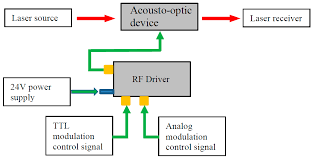
Figure 1: AOMD
Typically, AOM drivers operate at frequencies ranging from tens to hundreds of MHz, depending on the AOM design and application. While many systems use a fixed frequency matched to the modulator, applications such as acousto-optic deflectors, frequency shifters, and acousto-optic tunable filters often require tunable frequencies. RF output power can range from a few hundred milliwatts to several watts, with some applications requiring simple ON/OFF switching and others enabling continuous analog power control for accurate intensity modulation.
As part of electronics for photonics, AOM drivers belong to the broader category of modulator drivers and are widely used in laser systems, spectroscopy, beam steering, imaging, and industrial photonics applications.
Working of an Acousto-Optic Modulator Driver
An AOM driver works by generating a stable RF signal at the frequency required by the acousto-optic modulator. The signal is generated through an oscillator, controlled using analog or digital interfaces, and amplified to the required power level before being delivered to the modulator through an impedance-matched RF connection, typically 50 Ω, for efficient power transfer and minimal signal reflection.
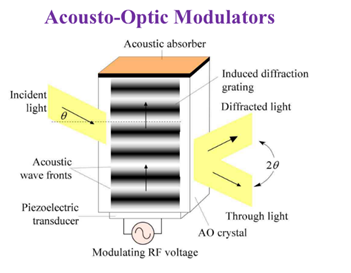
Figure 2: AOM
The amplified RF signal powers the piezoelectric transducer inside the AOM, generating acoustic waves that interact with the incoming laser beam. By controlling RF frequency and power, the driver enables precise modulation of laser intensity, frequency shifting, beam steering, and pulse control in photonic systems.
Main Components of an AOM Driver
Oscillator
The oscillator is the core signal-generation element of an AOM driver. It produces a stable RF signal at the required operating frequency. Crystal oscillators are commonly used for fixed-frequency applications due to their stability, while tunable systems may use voltage-controlled oscillators (VCOs) or Direct Digital Synthesizers (DDS) for adjustable and highly stable frequency control.
Control Interface
The control interface manages the RF signal and may include simple ON/OFF TTL triggering, analog power control, or programmable digital interfaces such as USB or Ethernet. Depending on the design, AOM drivers may provide linear or exponential RF power response for precise intensity control. Some advanced systems also use signal predistortion to compensate for nonlinearities and improve modulation accuracy.
Power Amplifier
The power amplifier boosts the RF signal to the level required by the acousto-optic modulator. RF output power can range from a few hundred milliwatts to several watts depending on the application. Different amplifier architectures offer trade-offs between efficiency and signal linearity, with some designs optimized for fixed frequencies and others supporting broadband operation for frequency-agile systems.
Impedance Matching and RF Connections
Proper impedance matching between the AOM driver and modulator is critical for efficient RF signal transmission. Most acousto-optic modulators (AOMs) are designed with a 50 Ω impedance, requiring the RF driver and amplifier to match this value to minimize signal loss and reflections.
If the impedance between the RF amplifier and AOM is mismatched, part of the RF signal can be reflected back toward the amplifier, reducing power transfer efficiency and potentially affecting system performance. Proper impedance matching ensures reliable operation, efficient power transfer, and consistent modulation performance.
AOM drivers are typically connected to modulators using suitable RF cables with SMA or BNC connectors. Most systems include a single RF output for one modulator, although multi-channel configurations are available for specialized applications.
Cooling Mechanisms
High-power RF operation generates heat, making thermal management important. Most high-power AOM drivers use conductive cooling through metal mounting plates to dissipate heat efficiently and maintain reliable performance.
Applications of Acousto-Optic Modulator Drivers
Acousto-optic modulator drivers (AOM drivers) are widely used in photonic and laser systems where fast and precise optical control is required. One of their most important applications is in laser Q-switching and pulse picking, where they rapidly switch laser beams on and off to control pulse timing and intensity. They are also extensively used in laser frequency shifting and spectroscopy, enabling precise adjustment of laser frequencies for scientific measurements and metrology.
In addition, AOM drivers play a key role in laser beam steering and scanning systems, where controlled diffraction is used for applications such as laser machining, microscopy, and imaging. They are also used in optical communications and signal processing to modulate laser intensity and manage optical signals with high speed and precision. In industrial and research environments, AOM drivers support advanced photonics applications requiring accurate beam modulation, power control, and frequency tuning.
Click here to learn more about acousto-optic modulator driver.
Gophotonics has listed Acousto-optic Modulator Drivers from the leading companies. Use the parametric search tool to find products based on your requirements.

