What are Radiometers?
A radiometer is a device designed to measure the intensity of radiant energy known as radiant flux. Radiant flux can either be the energy contained within a specific beam or that received from a range of solid angles. Radiometers are commonly used to detect radiation in the infrared, ultraviolet, or microwave regions of the electromagnetic spectrum.
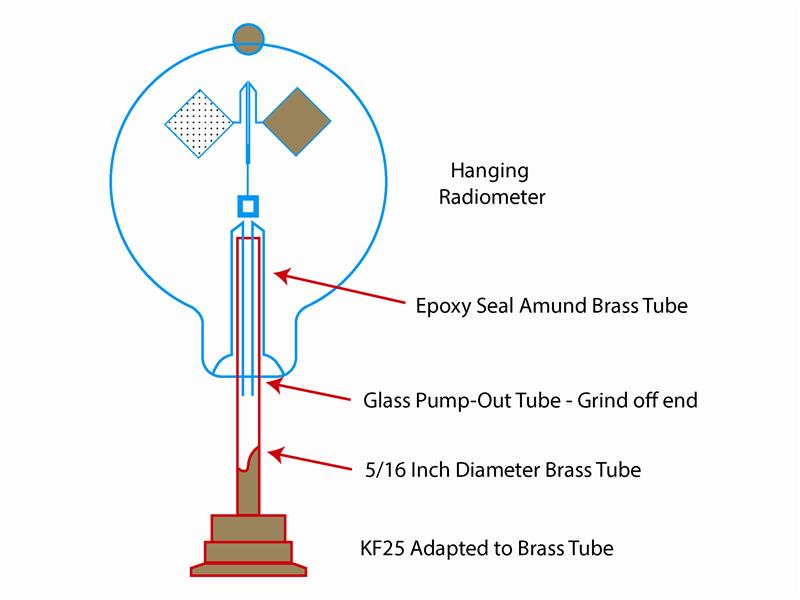
Radiometers play a critical role in various fields, including scientific research, industry, and medical applications. They p+rovide valuable data on radiation levels across different spectra, supporting studies in energy transfer, climate monitoring, weather forecasting, and medical diagnostics. In industrial applications, radiometers are used to measure irradiance (power per unit area) and radiance (the emission of radiation from a surface), which help in evaluating energy efficiency and ensuring safety standards related to radiation exposure.
Working Principle of a Radiometer
The fundamental working principle of a radiometer is to detect and measure radiant energy or electromagnetic radiation that interacts with its detector. While the specific operational mechanism varies depending on the type of radiometer, the overall principle involves converting radiant energy into a measurable output, whether mechanical motion (as in the Crookes radiometer) or an electrical signal (as in modern radiometers).
Crookes Radiometer
The Crookes radiometer, commonly known as a light-mill, is a device that visually demonstrates the interaction of light with matter in a low-pressure gas environment. It consists of an airtight glass bulb containing a partial vacuum and a rotor with four flat vanes mounted on a friction-reducing pivot. Each vane has two contrasting surfaces: a reflective (metallic or white) side and an absorbent black side.
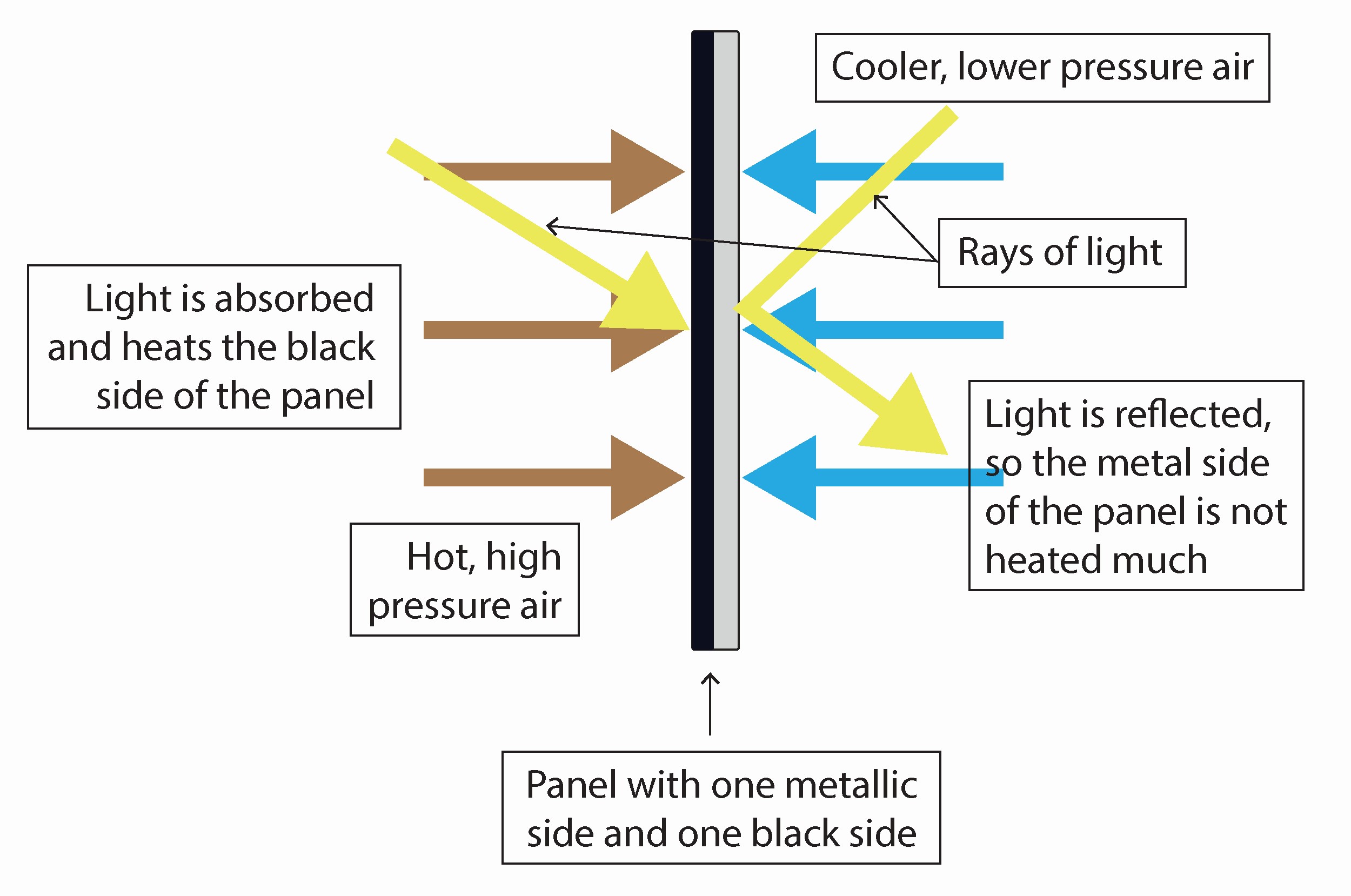
When exposed to light, the vanes begin to rotate, often reaching several thousand rotations per minute in bright sunlight. This motion occurs because light striking the black side is absorbed more efficiently, causing it to heat up, while the reflective side remains cooler by reflecting most of the incident light. The resulting temperature difference between the two sides leads to differences in the behavior of the surrounding gas molecules.
In the partial vacuum inside the bulb, gas molecules near the warmer black surface gain more kinetic energy and move faster, creating a higher local pressure than on the cooler reflective side. This pressure imbalance causes the gas to push against the vanes, producing rotation of the rotor.
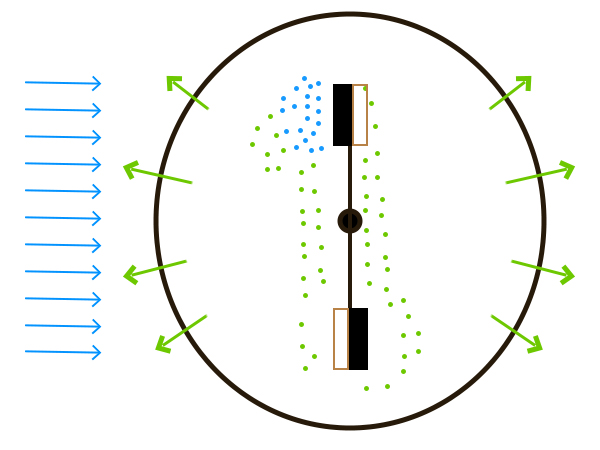
Contrary to early assumptions that the effect was caused by direct photon pressure, the motion is actually driven by gas dynamics associated with thermal creep or thermal transpiration, where temperature gradients create pressure differences. The lightweight, carefully balanced design of the vanes and their precise placement within the bulb are essential for smooth rotation, and the radiometer only functions correctly within an optimal vacuum range - too strong a vacuum results in insufficient gas molecules to generate pressure differences, while too much gas increases resistance and suppresses motion.
Nichols Radiometer
The Nichols radiometer differs from the Crookes radiometer in that it operates in a complete vacuum and directly measures photon pressure. In this device, photons from the incoming light strike the surface of the radiometer and exert a measurable force known as radiation pressure. Depending on the surface properties, the photons may be absorbed or reflected, with reflected photons transferring a greater amount of momentum. Because the Nichols radiometer functions in a complete vacuum, there is no influence from gas molecules, and the resulting motion of the rotor arises solely from photon pressure. This direct interaction makes the Nichols radiometer highly sensitive to the detection of very low levels of radiation.
Basic Components and Working of a Radiometer
Detector: The core component of the radiometer, the detector absorbs or reflects radiant energy and converts it into a measurable form. In modern radiometers, photocell sensors are used to convert light into electrical signals that can be processed for analysis.
Optical Filters: Optical filters isolate specific wavelengths or spectral regions, such as ultraviolet or infrared, depending on the application. These filters ensure precise measurements, particularly in narrow spectral ranges, enhancing the radiometer’s accuracy.
Vacuum Chamber: In radiometers like the Crookes model, a partial vacuum is crucial for proper operation. The vacuum chamber provides an environment where enough gas molecules remain to transfer heat but not impede movement. In contrast, the Nichols radiometer operates in a complete vacuum, where the absence of gas allows for direct photon measurement without interference.
Rotor and Vanes: The rotor and vanes are critical in radiometers like the Crookes model. These components convert absorbed energy into mechanical movement. As shown in Figure 1, the black and reflective sides of the vanes react differently to light, causing rotation due to heat-induced gas movement in the Crookes radiometer. In the Nichols radiometer, the vanes spin purely from the momentum imparted by photons.
Applications of Radiometers
Radiometers are used for measuring radiant intensity and irradiance of light sources, particularly in the ultraviolet and visible spectral regions. By quantifying radiant energy, they enable accurate evaluation of optical output from lamps, LEDs, and other radiation sources.
In industrial process monitoring, radiometers are applied to verify and control light-dependent processes. They are used to measure delivered irradiance from UV or visible sources to ensure consistent performance in applications where precise radiant energy levels are required.
Radiometers are widely used in quality control and inspection environments to confirm that radiation sources operate within specified intensity limits. Measuring irradiance helps maintain consistency and reliability of illumination systems used in inspection and testing setups.
In laboratory and research settings, radiometers support measurement and comparison of light source output during testing, calibration, and experimental analysis. Accurate radiometric data enables controlled evaluation of radiation levels under defined conditions.
Radiometers are also used for safety and exposure monitoring, where measurement of radiant energy helps assess and manage exposure to ultraviolet or intense light sources. This ensures that radiation levels remain within acceptable limits during operation.
Gophotonics has listed Optical Wavelength Meters from the leading companies. Use the parametric search tool to find products based on your requirements.

