5 Optical Phase Shifters
from
2 Manufacturers
5 Products
from
2 Manufacturers
What is an optical phase shifter?
An optical phase shifter (OPS) is a photonic device designed to precisely control the phase of light as it propagates through a waveguide or optical path, without significantly changing its amplitude. The device achieves this by altering the effective refractive index along the optical path, which modifies the optical path length and results in a controlled phase shift of the transmitted light. By precisely manipulating the phase, optical phase shifters enable modulation, switching, and signal processing in photonic integrated circuits (PICs). They are essential in silicon photonics, where they serve as the backbone for optical modulators, switches, interferometers, and emerging technologies like LiDAR and quantum photonics. Optical phase shifters play a crucial role in applications requiring high-speed data transmission, low power consumption, and compact integration on a chip.
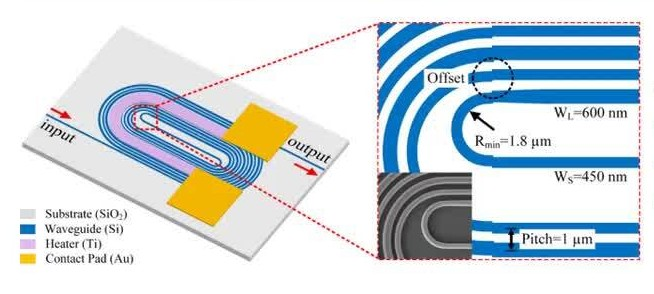
An optical phase shifter consists of a waveguide or optical path in which the effective refractive index can be dynamically altered. By adjusting the effective refractive index, the optical path length is modified, producing a precise phase shift (Δϕ) in the propagating light. Phase manipulation enables interference, modulation, and beam steering, which are foundational to photonic circuits.
Optical phase shifters are implemented across several photonic platforms:
- Silicon Photonics (SiPh): Silicon-based devices exploit the plasma dispersion effect, where the refractive index is modified by controlling free carriers through injection, depletion, or accumulation. This method is CMOS-compatible, enabling high-speed phase modulation suitable for modulators and switches in integrated circuits.
- Lithium Niobate on Insulator (LNOI): LNOI devices use the Pockels effect, a linear electro-optic phenomenon in non-centrosymmetric crystals, for ultra-fast and low-loss phase control. Their high electro-optic coefficients and broad bandwidth make them ideal for coherent optical communication and high-speed modulation.
- Hybrid III-V/Silicon Platforms: Combining III-V semiconductors (e.g., InP, InGaAsP) with silicon waveguides leverages the strong electro-optic response of III-V materials while maintaining the integration advantages of silicon. This hybrid approach improves modulation efficiency, reduces device footprint, and lowers operating voltage.
- MEMS-Based Phase Shifters: Micro-electro-mechanical systems (MEMS) manipulate phase by mechanically altering the optical path or waveguide coupling. MEMS devices offer broadband operation, precise phase control, and low optical loss, making them suitable for tunable photonic circuits and optical switches.
- Nonlinear Photonic Materials: All-optical phase shifters employ nonlinear effects, such as the Kerr effect or two-photon absorption, where high-intensity control light induces refractive index changes. This enables ultrafast, passive phase modulation for optical signal processing and photonic computing.
Design considerations for optical phase shifters include mode confinement to maximize light–material interaction, effective index overlap for efficient modulation, and minimization of optical loss to preserve signal integrity. Other practical factors include thermal stability, device footprint, and compatibility with large-scale PIC integration.
Working Principle of the Optical Phase Shifter
As light propagates through a waveguide, its phase (ϕ) is determined by both the effective refractive index (neff) of the guiding medium and the physical length (L) of the waveguide:
ϕ = (2πneffL)/λ
Where, λ is the free-space wavelength.
A phase shift (Δϕ) is achieved by dynamically modulating either the effective refractive index (neff) or the physical length (L) of the waveguide, which changes the optical phase without significantly affecting the light’s amplitude. This allows precise control of interference, high-speed modulation, beam steering, and signal routing in photonic integrated circuits.
Mechanisms of Phase Shifting in Photonics
Thermo-Optic Effect: Localized heating changes the refractive index n(T) of the waveguide material, enabling moderate-speed phase modulation. This effect is commonly used in silicon, polymer, and LNOI platforms.
Electro-Optic Effect:
- Pockels Effect: Linear refractive index change in non-centrosymmetric materials (e.g., LiNbO₃, BaTiO₃) under an applied electric field.
- Plasma Dispersion Effect: Free-carrier density modulation in silicon waveguides alters the refractive index and absorption, enabling high-speed modulation.
Mechanical (MEMS) Phase Shifters: Electrostatic or piezoelectric actuators mechanically adjust waveguide geometry or coupling gaps to control phase with minimal optical loss.
All-Optical Phase Shifters: Nonlinear optical effects (e.g., Kerr effect) allow light to modulate light. High-intensity control beams induce refractive index changes in nonlinear materials, enabling ultrafast, passive phase modulation.
Applications of Optical Phase Shifters
Optical phase shifters are used in optical modulators, where devices such as Mach-Zehnder and micro-ring modulators employ them to encode data onto optical carriers. In addition, they enable optical switches by allowing reconfigurable routing in photonic networks.
They are also essential for interferometers and coherent detection, as Mach-Zehnder and Michelson interferometers, along with coherent receivers, rely on precise phase control. Optical phased arrays (OPA) and LiDAR systems use arrays of phase shifters to steer optical beams, supporting 3D imaging and mapping applications.
In quantum photonics, phase shifters allow phase manipulation to enable interference, entanglement, and quantum information processing. Furthermore, in photonic computing and neural networks, they are used to implement analog matrix-vector multiplication and weighted signal processing.
Gophotonics has listed Optical Phase Shifters from the leading companies. Use the parametric search tool to find products based on your requirements.

