11 Electro-Optic Deflectors
from
3 Manufacturers
11 Products
from
3 Manufacturers
Page 1 of 1
What are Electro-optic deflectors (EODs)?
Electro-optic deflectors (EODs) are optical devices used to steer or deflect light beams by applying an electric field to a specialized optical crystal. Unlike mechanical beam steering systems that rely on moving mirrors, electro-optic deflectors enable high-speed, non-mechanical beam control with exceptional precision and responsiveness. They are widely used in laser scanning, optical communications, microscopy, laser printing, spectroscopy, and scientific research, where rapid and accurate laser beam positioning is essential.
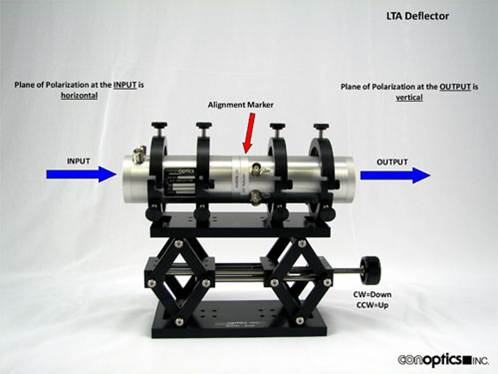
Figure 1: Electro-optic deflector
Electro-optic deflectors operate based on the electro-optic effect, where the refractive index of certain crystals changes in response to an applied electric field. This change alters the propagation path of light, allowing the laser beam to be redirected at extremely high speeds. Compared to traditional mirror-based systems, electro-optic deflectors provide faster beam steering and highly precise optical control.
Working of an Electro-Optic Deflector
An electro-optic deflector works by manipulating the refractive properties of an optical crystal using an applied electric field. When voltage is applied to the crystal, its refractive index changes, causing the direction of the incoming light beam to shift. By adjusting the applied voltage, the beam can be redirected with high precision and extremely fast response times.
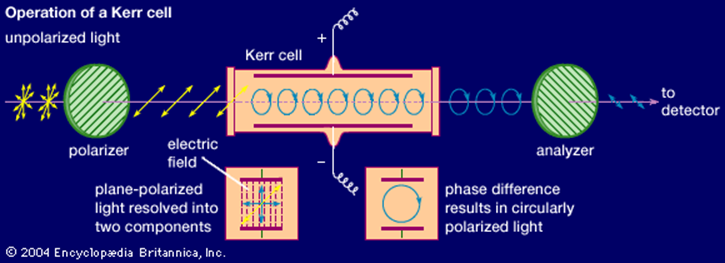
Figure 2: Electro Optic Effect
The operating principle of electro-optic deflectors is primarily based on the Pockels effect, where certain crystals exhibit an instantaneous change in refractive index when exposed to an electric field. This enables beam steering in nanoseconds, making electro-optic deflectors ideal for high-speed optical systems requiring rapid switching and accurate beam positioning.
Main Components of an Electro-Optic Deflector
Electro-Optic Crystals
The core component of an electro-optic deflector is the electro-optic crystal, which changes its optical properties when an electric field is applied. Common materials include lithium niobate, potassium dihydrogen phosphate (KDP), and beta-barium borate (BBO), selected based on wavelength compatibility, response speed, and deflection requirements.
Voltage-Controlled Elements
Voltage-controlled elements apply controlled electric fields to the electro-optic crystal, enabling precise beam steering. Fast voltage switching allows rapid changes in beam direction, supporting high-speed optical scanning and beam manipulation.
Control Electronics
Advanced control electronics regulate the applied voltage and beam steering behavior. Depending on the application, systems may include programmable interfaces for dynamic beam positioning and synchronization with laser or imaging systems.
Thermal and Material Considerations
The performance of electro-optic deflectors depends on crystal properties, wavelength compatibility, and thermal stability. Proper material selection and thermal management help maintain precise beam alignment and reliable performance in demanding photonics applications.
Applications of Electro-Optic Deflectors
Electro-optic deflectors are widely used in applications requiring fast and precise laser beam control. One of their most important applications is in laser scanning systems, where they rapidly steer beams for applications such as laser printing, barcode scanning, microscopy, and laser imaging.
They also play an important role in optical communications, helping switch and route optical signals in fiber-optic networks for high-speed data transmission. In scientific research, electro-optic deflectors are used in microscopy, spectroscopy, and precision optical experiments that require rapid beam positioning and accurate light control.
In industrial laser systems, electro-optic deflectors support laser processing, beam steering, and optical measurement systems, enabling improved precision and faster operation.
Click here to learn more about electro optic deflectors.
Gophotonics has listed Electro Optic Deflectors from the leading companies. Use the parametric search tool to find products based on your requirements.

