What is a Spatial Light Modulator (SLM)?
A Spatial Light Modulator (SLM) is an optical device that can dynamically modify the spatial properties of a light beam. Unlike fixed optical elements such as lenses or gratings, an SLM consists of a two-dimensional array of individually addressable pixels. By controlling each pixel independently, the device can impose a programmable pattern onto the incoming light, affecting its phase, amplitude, polarization, or a combination of these properties. Because the modulation can be updated in real time, SLMs function as versatile, reconfigurable optical components used in a wide range of scientific and industrial systems.
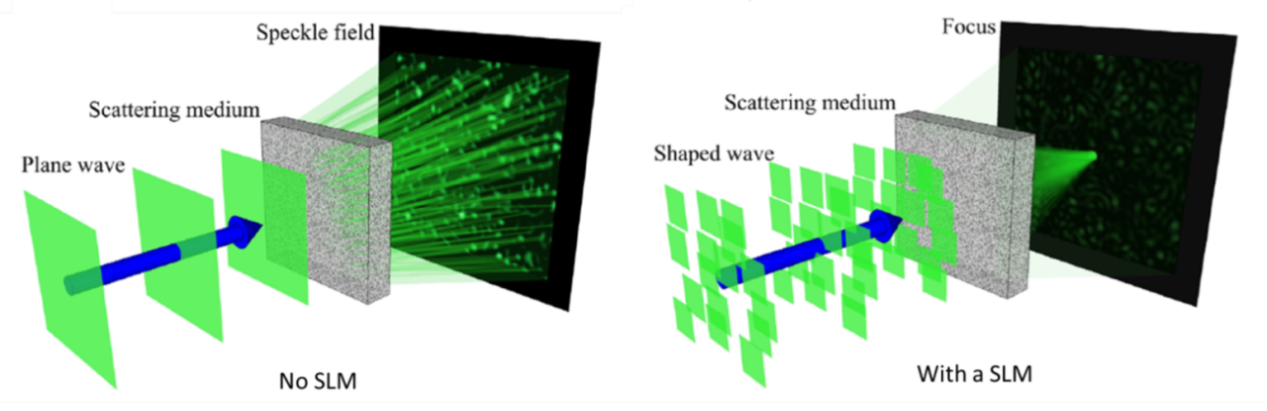
Working Principle of SLM
An SLM operates on the principle of controlling the spatial distribution of light through electronically addressable pixels. When a beam of light illuminates the device, each pixel can independently modify a particular property of that light - such as its phase, amplitude, or polarization - based on the electrical signal applied to it. By creating a programmed pattern of pixel states, the SLM imposes a corresponding optical modulation across the entire beam.
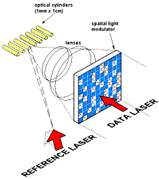
This modulation occurs because the physical mechanism within each pixel alters how the incoming light interacts with that region of the device. Depending on the technology, this may involve reorienting liquid crystal molecules, tilting microscopic mirrors, or deforming a reflective surface. These microscopic changes affect the optical path length, intensity transmission, reflection angle, or polarization of the light at that pixel. When the light exits the surface, the combined effect of all pixels produces a customized wavefront or intensity pattern that can be updated in real time.
Because every pixel can be controlled independently, the SLM behaves like a reconfigurable optical mask or a digital wavefront generator. It can transform a uniform laser beam into a tailored optical field simply by updating the pixel pattern electronically, without any mechanical movements. This flexibility makes SLMs uniquely powerful for applications requiring rapid, precise, and complex control over light.
Types of SLMs
1. Liquid Crystal SLMs (LC-SLMs)
These devices use the voltage-dependent orientation of liquid crystal molecules to modulate light. When an electric field is applied, the molecules tilt, changing the effective refractive index experienced by a specific polarization. As a result, the optical path length varies, allowing precise phase modulation across the pixel array. LC-SLMs offer high spatial resolution and smooth phase control, making them suitable for holography and beam shaping, although their response speed is relatively slow due to the physical relaxation time of liquid crystals.
2. Liquid Crystal on Silicon (LCoS) SLMs
LCoS technology places the liquid crystal layer on top of a reflective silicon backplane that contains the addressing electronics. This configuration enables very high pixel density, excellent fill-factor, and low optical distortion. LCoS SLMs are commonly used for phase-only modulation because they can produce finely tuned spatial phase patterns with high accuracy, which is essential for demanding applications such as computer-generated holography and adaptive optics.
3. Digital Micromirror Devices (DMD/MEMS SLMs)
These SLMs consist of arrays of tiny mirrors fabricated on a microelectromechanical (MEMS) platform. Each mirror can tilt between discrete angles under electronic control, effectively switching pixels on or off or directing light into different diffraction orders. Because mechanical actuation is extremely fast, DMD-based SLMs excel in high-speed amplitude or binary phase modulation. They are widely used in structured illumination, optical pattern projection, and high-speed imaging systems.
4. Deformable Mirrors
Instead of using liquid crystals or discrete micromirrors, deformable mirrors rely on a reflective surface supported by multiple actuators. By pushing or pulling on different regions, the mirror surface smoothly deforms, creating a continuous wavefront modification. This approach provides high optical quality and fast control, making deformable mirrors a cornerstone of adaptive optics systems in astronomy, laser beam correction, and high-power laser shaping.
5. Electro-Optic and Acousto-Optic SLMs
Some SLMs use materials whose optical properties change under an applied electric field (electro-optic effect) or under the influence of acoustic waves (acousto-optic effect. These devices offer extremely fast response times, often in the microsecond or sub-microsecond regime, but they usually have lower spatial resolution and limited aperture sizes. They are therefore chosen for applications where speed is more important than spatial complexity.
Applications of SLMs
SLMs are central to modern holography because they can display dynamic, computer-generated holograms. By precisely shaping the phase profile of a beam, they create arbitrary three-dimensional optical fields, enabling holographic displays, optical trapping systems, and advanced diffractive optical elements that can be reprogrammed without replacing hardware.
In laser systems, SLMs allow the transformation of a beam into virtually any desired profile, including flat-top, vortex, Bessel, or multi-spot patterns. They also enable wavefront correction by compensating for distortions introduced by optical components or the propagation medium. This capability is essential in high-power laser research, material processing, and free-space optical communication.
SLMs enable structured illumination, dynamic focal control, and wavefront correction to improve resolution and contrast in advanced microscopy. They are used in light-sheet microscopy, confocal systems, and adaptive imaging, where correcting aberrations introduced by biological samples is crucial for achieving clear images deep inside tissues.
SLMs play a growing role in mode-division multiplexing, spatial encoding, and reconfigurable optical interconnects. By modulating spatial modes or applying programmable diffractive patterns, they help route, encode, and manipulate optical signals in free-space and fiber-based communication systems.
They provide dynamic control of the energy distribution on the workpiece, enabling multi-spot drilling, surface structuring, and depth-controlled ablation. Because the pattern can be changed in real time, the same laser system can perform different tasks without mechanical reconfiguration.
In projection and display technologies, SLMs generate high-resolution images by modulating light pixel-by-pixel. They are used in holographic displays, augmented and virtual reality devices, and 3D sensing systems where flexible pattern generation is essential.
Gophotonics has listed Spatial Light Modulators from the leading companies. Use the parametric search tool to find products based on your requirements.

