What are Optical Crystals?
Optical crystals are highly pure natural or synthetic crystalline materials engineered to precisely manipulate, guide, and transform light at the atomic lattice level. Their long-range structural order enables properties such as birefringence, electro-optic modulation, optical gain, and nonlinear frequency conversion, none of which can be realized in amorphous optical glasses. Unlike passive transparent materials, many optical crystals actively interact with electromagnetic fields through gh anisotropic refractive indices or nonlinear polarization responses, allowing functions such as frequency doubling, parametric generation, polarization control, and phase modulation.
The performance of an optical crystal depends strongly on its composition, lattice symmetry, defect density, and doping profile, all of which tailor its transparency window, nonlinear coefficients, thermal stability, and damage threshold. For example, trigonal, tetragonal, and monoclinic structures often support strong second-order nonlinear interactions, while doped garnet crystals provide high optical gain for solid-state laser systems. These engineered characteristics make optical crystals indispensable in laser resonators, ultrafast frequency converters, optical modulators, and high-precision photonic instrumentation applications.
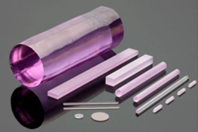
Fig: Optical Crystal
Working of Optical Crystals
Optical crystals control and transform light based on the structure and anisotropy of their crystal lattice. When light enters a crystal, its electric field polarizes the medium, and the way this induced polarization responds determines how the light propagates, slows, splits, or changes frequency. In many crystals the refractive index varies with direction, allowing the material to alter a beam’s speed, polarization state, phase, or wavelength with high precision. Nonlinear crystals respond more strongly to intense electromagnetic fields, enabling effects such as harmonic generation and frequency mixing. Gain crystals doped with active ions can amplify light through stimulated emission, forming the core of solid-state lasers.
When polarized light enters a birefringent crystal at an angle, as in Figure 1(a), it splits into an ordinary ray and an extraordinary ray, each following a different trajectory because each experiences a different refractive index. In Figure 1(b), where the light enters perpendicular to the optical axis, both rays propagate along co-axial paths but still maintain different velocities inside the crystal. In Figure 1(c), when the light travels parallel to the optical axis, birefringence disappears and the rays propagate without separation. These directional dependencies allow optical crystals to precisely control polarization, phase, and propagation of light, forming the basis for waveplates, modulators, filters, and many other photonic components.
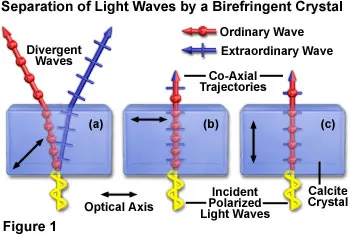
Figure 1(a), for the oblique case, and Figure 1(b) for the situation where incident light is perpendicular to the optical axis of a birefringent crystal. Figure 1(c) incident light rays impact the crystal in a direction that is parallel to the optical axis
Types of Optical Crystals
1. Linear Optical Crystals: Linear optical crystals respond proportionally to the intensity of incident light and are widely used for polarization manipulation, beam displacement, and optical filtering.
Examples:
- Quartz: Quartz is a strong birefringent crystal used in waveplates and polarizers because it provides stable optical properties over a broad spectral range. Its excellent thermal and mechanical stability makes it ideal for metrology and precision optics.
- Calcite: Calcite exhibits very high birefringence, allowing clear separation of ordinary and extraordinary beams. It is commonly used in beam splitters and polarization analyzers requiring high optical purity.
- Sapphire: Sapphire offers moderate birefringence along with exceptional hardness and thermal conductivity. It is often chosen for high-power optical windows and cryogenic applications.
2. Nonlinear Optical (NLO) Crystals
Nonlinear crystals exhibit higher-order optical responses under intense illumination, enabling efficient wavelength conversion processes such as harmonic generation, optical parametric oscillation, and frequency mixing.
Examples:
- BBO (Beta-Barium Borate): BBO supports wide transparency and high damage thresholds, making it suitable for second and third harmonic generation in UV to visible lasers. It is frequently used in ultrafast systems requiring broad phase-matching bandwidth.
- LBO (Lithium Triborate): LBO provides excellent thermal stability and low walk-off, allowing efficient high-power frequency conversion. Its wide acceptance angle makes it ideal for optical parametric oscillators and SHG of Nd-based lasers.
- KTP (Potassium Titanyl Phosphate): KTP has high nonlinear coefficients and is widely used for frequency doubling of 1064 nm lasers. It supports efficient noncritical phase matching, making it suitable for compact green laser systems and electro-optic devices.
- KDP / DKDP: KDP and its deuterated form DKDP offer high optical quality and low absorption, ideal for large-aperture frequency conversion in high-energy laser facilities. They are also used in Pockels cells for Q-switching due to their strong electro-optic response.
3. Laser Crystals
Laser crystals are doped materials that provide optical gain through stimulated emission and form the core of solid-state laser systems.
Examples:
- Nd:YAG: Nd:YAG is the most widely used solid-state laser crystal, providing strong gain at 1064 nm and efficient pumping by laser diodes. Its robustness and high thermal conductivity make it suitable for industrial, medical and scientific lasers.
- Ti:Sapphire: Ti:Sapphire offers extremely broad tunability from around 650 to 1100 nm, enabling femtosecond pulse generation. It is a cornerstone of ultrafast lasers due to its wide emission bandwidth and excellent optical gain.
- Cr⁴⁺:YAG: Cr⁴⁺:YAG functions as a passive Q-switch in Nd-based lasers by providing saturable absorption at 1064 nm. It reliably generates high-peak-power pulses and is valued for its simplicity and durability.
Applications of Optical Crystals
Optical crystals are fundamental to modern laser technology. Laser crystals such as Nd:YAG and Ti:Sapphire are used as gain media in industrial machining lasers, scientific ultrafast systems, and medical surgical lasers. Nonlinear crystals like BBO and LBO enable frequency doubling, wavelength tuning, and the generation of coherent light at wavelengths not directly accessible from laser sources, making them indispensable in spectroscopy, precision metrology, and remote sensing.
In optical communications, crystals support high-speed signal processing, wavelength conversion, and electro-optic modulation. Lithium niobate, KTP, and related materials are widely used in modulators, switches, and wavelength management devices that form the backbone of fiber-optic networks. Their stability, high bandwidth, and precise refractive-index control enable advanced optical routing and signal conditioning in telecom and datacenter infrastructures.
Optical crystals also play a critical role in sensing, imaging, and instrumentation. Birefringent crystals are used in interferometers, microscopes, and polarization-based sensors. Nonlinear crystals enhance imaging contrast through harmonic generation techniques, while specialty crystals support detectors, scintillators, thermographic imaging, and environmental monitoring systems. The combination of transparency, high damage thresholds, and engineered optical response makes optical crystals vital across scientific research, industrial inspection, biomedical diagnostics, and aerospace applications.
Gophotonics has listed Optical Crystals from the leading companies. Use the parametric search tool to find products based on your requirements.

