What are Photomultipliers?
Photomultipliers, commonly known as PMTs, are highly sensitive photoemissive detectors designed to measure extremely low optical signal levels, even down to single photons. MTs use the photoelectric effect to generate electrons from incident photons and then amplify these electrons through a cascading chain of dynodes, achieving gains of up to 10⁶ - 10⁸. This extraordinary internal amplification allows PMTs to detect light levels far below the threshold of standard semiconductor photodetectors - even down to individual photons.
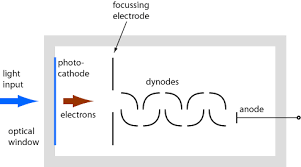
Designed for precision and speed, photomultipliers offer high temporal resolution, very low dark noise, and broad spectral sensitivity that spans from the ultraviolet to the near-infrared. Their ability to provide fast, low-noise, and high-gain signal detection makes them indispensable in applications such as fluorescence spectroscopy, scintillation counting, medical imaging, nuclear and particle physics experiments, LiDAR systems, and astronomical instrumentation. In any environment where light levels are extremely low or timing accuracy is critical, PMTs serve as the preferred photodetection technology.
Working Principle of Photomultipliers
The operation of a photomultiplier tube (PMT) depends on two fundamental physical processes: photoemission and electron multiplication. These processes work sequentially, allowing the PMT to convert extremely weak optical signals into strong, measurable electrical outputs.
1. Photoemission at the Photocathode: The detection process begins the moment light enters the PMT through the entrance window. This window is designed to transmit specific wavelength ranges with minimal loss, ensuring that the maximum amount of light reaches the photocathode beneath it. As photons pass through the window, they encounter the photocathode, a specially engineered light-sensitive material such as bialkali, multialkali, GaAs, or Cs-Te.
When a photon is absorbed by the photocathode, it transfers its energy to an electron in the material. If the photon has enough energy to overcome the material’s work function, the electron is ejected - a phenomenon known as the photoelectric effect. This emitted electron, called a photoelectron, represents the first step in the amplification process. Since many applications involve extremely weak or even single-photon signals, producing even one photoelectron with high reliability is essential.
2. Electron Multiplication Through Dynodes: Once the initial photoelectron is produced, it is guided and accelerated through the interior of the PMT by an applied high voltage. The tube contains a series of electrodes called dynodes, each maintained at a progressively higher electrical potential. As the photoelectron accelerates toward the first dynode, it gains kinetic energy. When it strikes the dynode surface, this energy is transferred in the form of secondary electron emission.
In other words, one incoming electron can cause several electrons to be released from the dynode surface. These newly freed electrons are then accelerated toward the next dynode, where the process repeats. Because each dynode produces multiple electrons from every incoming electron, the signal undergoes exponential amplification as it moves down the chain. With typically 8 - 14 dynode stages, the PMT achieves total gains on the order of 10⁶ to 10⁸, meaning a single photon can be converted into millions of electrons.
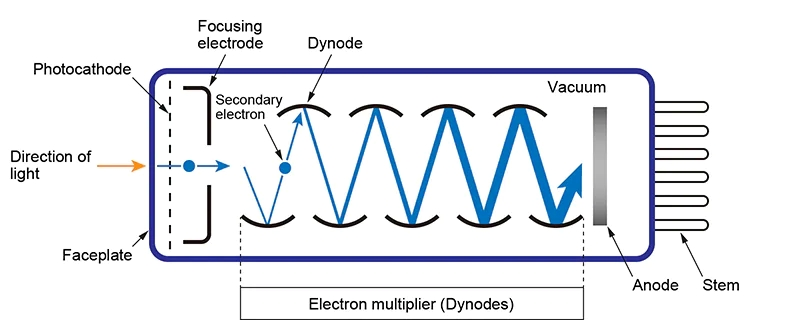
Eventually, the large cloud of multiplied electrons reaches the anode, where the charge is collected and converted into an electrical pulse. Since the number of electrons generated is proportional to the number of incident photons, the output signal accurately represents the light intensity - even when it is extremely small.
Performance Characteristics of PMTs
Photomultiplier tubes combine several key attributes that make them exceptionally effective in detecting extremely low optical signals.
1. Ultra-High Sensitivity: PMTs can detect extremely faint light, even down to single photons. This makes them ideal for applications where only a very small number of photons are produced, such as fluorescence detection or scintillation events, because they can capture signals that other detectors would miss.
2. Very Low Dark Current: Dark current is the noise generated by the detector in the absence of light. PMTs naturally have very low dark current, meaning they add very little background noise. As a result, weak signals stand out more clearly, improving accuracy in low-light measurements.
3. Large and Uniform Photocathode Area: The photocathode in a PMT is relatively large and maintains uniform sensitivity across its surface. This allows efficient light collection over a broader area and ensures that the detector response is consistent regardless of where the light hits, contributing to stable and reliable output.
4. Fast Nanosecond Response Time: PMTs can respond to changes in light intensity within nanoseconds. This enables them to measure fast optical pulses and rapid signal fluctuations, which is essential in time-resolved spectroscopy, pulsed-laser experiments, and high-speed optical detection.
5. Broad and Customizable Spectral Range: Different photocathode materials allow PMTs to detect light across a wide range - from deep ultraviolet to near-infrared. This flexibility ensures that the detector can be tailored to the exact wavelength range required for a specific experiment or application.
6. High Signal-to-Noise Ratio (SNR): Because PMTs combine high sensitivity, low noise, and fast response, they naturally deliver a strong signal relative to background noise. This high SNR ensures that even very weak optical signals can be measured cleanly and with excellent reliability.
Design Options and Materials
1. Photocathode Materials Determine Spectral Sensitivity
- Bialkali: It provides high quantum efficiency in the visible spectrum while maintaining low intrinsic noise, making it suitable for low-light applications such as fluorescence and scintillation detection.
- Multialkali: Multialkali extends spectral sensitivity from the visible region into the near-infrared, allowing broader detection coverage for instruments that require wideband response.
- GaAs / InGaAs: This material utilizes compound semiconductor technology to achieve superior sensitivity in the red and NIR regions, making these photocathodes ideal for telecommunications, biology, and astronomy applications.
2. Window Materials Define the Usable Wavelength Range
- Borosilicate Glass: A robust and cost-effective window material that supports detection across the visible range, suitable for general-purpose photometric systems.
- UV-Grade Quartz: UV-grade quartz offers high ultraviolet transmission and minimal absorption, enabling PMTs to operate effectively in UV-sensitive tasks such as spectroscopy and environmental monitoring.
- Magnesium Fluoride (MgF2): MgF2 provides excellent transparency into the deep UV region with very low optical loss, making it essential for specialized deep-UV detection and high-precision optical measurements.
3. Structural Configurations Influence Light Collection and Performance
- Side-On PMTs: These side-on PMTs feature extended photocathode areas and a geometry that maximizes light-collection efficiency, well-suited for spectroscopy, analytical instruments, and environmental monitoring setups.
- Head-On PMTs: They are designed for uniform photocathode illumination and accurate optical alignment, making them the preferred choice in imaging systems and precision scientific instruments.
- Microchannel Plate PMTs (MCP-PMTs): MCP-PMTs employ dense arrays of microscopic electron-multiplying channels to deliver ultra-fast response times, high temporal resolution, and exceptionally low dark noise for timing-critical applications such as particle physics and LiDAR.
4. Customization Enables Application-Specific Optimization
- Material choices: Selecting specific photocathode compositions allows users to target sensitivity in the visible, ultraviolet, or near-infrared bands depending on their detection needs.
- Window types: Different optical window materials ensure maximum transmission and minimal absorption at the desired wavelengths, improving overall detector efficiency.
- Structural designs: Custom PMT architectures - including side-on, head-on, and MCP configurations - enable optimization for tasks ranging from high-speed photon timing to wide-area imaging and low-light photometry
Advantages of PMTs vs. APDs and SiPMs
Although avalanche photodiodes (APDs) and silicon photomultipliers (SiPMs) have grown popular for compact, solid-state detection, PMTs continue to offer superior performance in several critical areas. Their internal gain, typically in the range of 10⁶ to 10⁸, is significantly higher than that of APDs, enabling the detection of optical signals that would otherwise be lost beneath the noise floor of semiconductor detectors. PMTs also feature large active detection areas and exceptionally low dark current, making them particularly advantageous in photon-starved applications such as scintillation detection, deep-space astronomy, and ultra-low-light spectroscopy. Furthermore, PMTs offer a broader spectral response that can extend from the ultraviolet to the near-infrared, depending on photocathode material, whereas SiPMs are often constrained by the absorption properties of silicon.
In applications requiring high-speed performance, PMTs deliver rapid rise times and outstanding timing resolution, outperforming many solid-state detectors in tasks such as time-correlated single-photon counting (TCSPC) and fast pulse characterization. While APDs and SiPMs provide benefits in size, ruggedness, and low-voltage operation, PMTs remain the preferred choice when extremely low noise, high gain, wide dynamic range, and large detection areas are essential.
Applications of Photomultipliers
Photomultiplier tubes are essential in systems that require detection of extremely weak optical signals with high temporal precision.
- Fluorescence and Absorption Spectroscopy - PMTs can detect faint emissions from low-concentration samples with high sensitivity.
- Nuclear and Particle Physics - It is used in scintillation and Cherenkov detectors to convert weak light flashes into measurable electrical pulses.
- Biomedical Imaging - This device is essential in PET scanners, bioluminescence imaging systems, and confocal microscopes for fast, low-noise signal detection.
- Environmental and Radiation Monitoring - It enables highly sensitive detection of low radiation levels and optical signals in safety and monitoring systems.
- LiDAR Systems - PMTs provide high gain and fast response for detecting low-intensity return signals.
- Astronomy and Space Science - Extremely weak photon flux from distant celestial sources can be detected using PMTs.
Gophotonics has listed Photomultipliers from the leading companies. Use the parametric search tool to find products based on your requirements.

