27 Terahertz Detectors
from
8 Manufacturers
27 Products
from
8 Manufacturers
Page 1 of 2
What is a Terahertz Detector?
A Terahertz Detector is a sensing device that converts terahertz radiation into a measurable electrical signal. Terahertz radiation occupies the region between microwaves and infrared light and typically spans frequencies from 0.1 THz to 10 THz, corresponding to wavelengths from 3 mm to 30 μm. These detectors can provide information on the amplitude, phase, spectral, temporal, or polarization characteristics of the radiation, and are essential for applications in terahertz spectroscopy, imaging, communications, and material analysis.
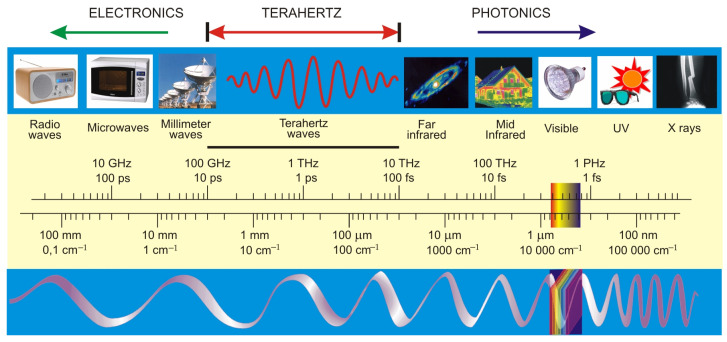
Fig: The electromagnetic spectrum
Working Principle of a Terahertz Detector
The working principle of a terahertz detector is generally divided into two main approaches, direct detection and heterodyne detection. These two methods differ in how the terahertz signal is captured, processed, and converted into an electrical output.
In direct detection, the terahertz detector absorbs the incoming THz radiation and directly converts it into an electrical signal. Since the generated signal is typically very small, it is immediately amplified using a low noise preamplifier. The performance of the entire system is strongly influenced by the combined behavior of the detector and the preamplifier, because any noise from either component degrades the measurement accuracy. Noise sources include the detector material itself, background radiation, and electronic circuitry. When the signal is weak or when noise must be further reduced, techniques such as lock in detection are used. Lock in detection enhances the signal to noise ratio by focusing on a known reference frequency, allowing accurate extraction of very weak terahertz signals.
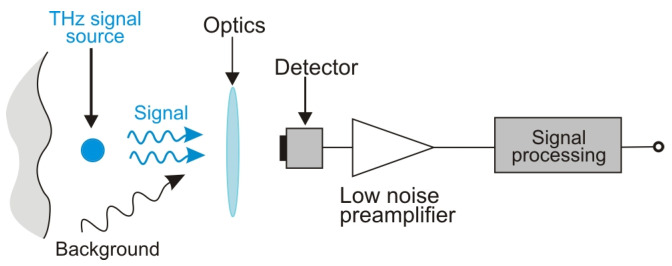
Fig: Direct detection method
In heterodyne detection, the incoming terahertz signal is mixed with a second signal known as a local oscillator. The mixing process produces an intermediate frequency signal that carries both the amplitude and the phase information of the original terahertz wave. This method allows extremely precise measurement of frequency components and provides very high spectral resolution. Because heterodyne systems preserve both amplitude and phase, they are widely used in advanced spectroscopy, coherent imaging, and applications requiring detailed signal analysis
THz detectors can be classified based on:
1) Operation principles
These detectors sense THz radiation by measuring the temperature rise caused when the radiation is absorbed. The change in temperature alters a physical property (like resistance or polarization), which is then converted into an electrical signal.
Photon detectors work by directly absorbing THz photons and generating charge carriers (electrons or holes). Their response is typically fast and sensitive, but they may require cooling depending on the material.
- Rectification-based detectors
These detectors use nonlinear electronic components like Schottky diodes or field-effect transistors to rectify the high-frequency THz signal into a measurable DC voltage.
2) Materials
Made using standard silicon CMOS technology, these detectors offer low-cost fabrication, compact integration with electronics, and suitability for large-area THz imaging arrays.
These rely on metal-based structures (antennas, bolometers, or thermoelectric devices) that absorb THz radiation and convert it into heat or electrical signals. They often provide broadband response.
- III–V material-based detectors
Fabricated from III–V compound semiconductors (such as GaAs, InP, GaN), these detectors offer high electron mobility, fast response, and strong THz absorption, making them ideal for high-performance THz sensing.
- Two-dimensional materials
Detectors based on 2D materials like graphene, MoS₂, or black phosphorus exploit ultrafast carrier dynamics, high mobility, and strong light–matter interaction to achieve sensitive THz detection at room temperature.
Applications of Terahertz Detectors
Terahertz detectors are widely used in security screening because terahertz waves can pass through clothing, plastics, and packaging. This makes them useful for detecting concealed objects in airports, border control, and parcel inspection systems. Since terahertz radiation is non ionizing, it provides a safer alternative to X-ray-based methods.
In industrial settings, terahertz detectors enable non-destructive testing in pharmaceuticals, food processing, and ceramics. They help verify tablet composition, detect impurities in packaged food, and analyze agricultural products. In the ceramics and automotive industries, terahertz systems identify defects, inclusions, density variations, and corrosion inside materials without damaging them.
Terahertz detectors also play an important role in science and medicine. They are used in spectroscopy to study materials, in research on high-speed wireless communication, and in laboratory imaging systems. In medical applications, their strong interaction with water-rich tissues enables non-invasive diagnostics, early disease detection, and dental imaging.
Gophotonics has listed Terahertz Detectors from the leading companies. Use the parametric search tool to find products based on your requirements.

