80 Optical Frequency Converters
from
12 Manufacturers
80 Products
from
12 Manufacturers
Page 1 of 8
What is an Optical Frequency Converter?
Optical frequency converters are devices that change the frequency - or equivalently, the wavelength of light. This process is vital in many scientific and industrial applications because not all light sources, such as lasers, can directly produce the exact wavelength needed for a specific task. For instance, many laser systems naturally emit infrared light, but applications in biology or telecommunications may require visible, ultraviolet, or mid-infrared light. Optical frequency converters make it possible to bridge this gap by using nonlinear optical processes to shift the frequency of the light beam.
The core principle behind these converters lies in nonlinear optics. In normal (linear) optical systems, light travels through a material without changing its basic properties. However, in nonlinear optical materials - those with a strong interaction between light and matter - the intense electromagnetic field of a laser beam can modify the optical properties of the material. When light with high intensity enters such a material, new frequencies can be generated based on how the electric field of the light interacts with the atomic structure of the crystal.
One of the most common frequency conversion methods is second-harmonic generation, where the frequency of the incoming light is doubled. For example, an infrared laser emitting at 1064 nanometers can be converted into green light at 532 nanometers. This is how many green laser pointers operate: they start with an infrared laser and use a nonlinear crystal to double the frequency. Other techniques include sum-frequency generation, where two different light waves combine to produce a new wave at the sum of their frequencies, and difference-frequency generation, which produces a new wave at the frequency difference of two inputs. These processes allow engineers and scientists to access regions of the electromagnetic spectrum that are otherwise difficult to reach.
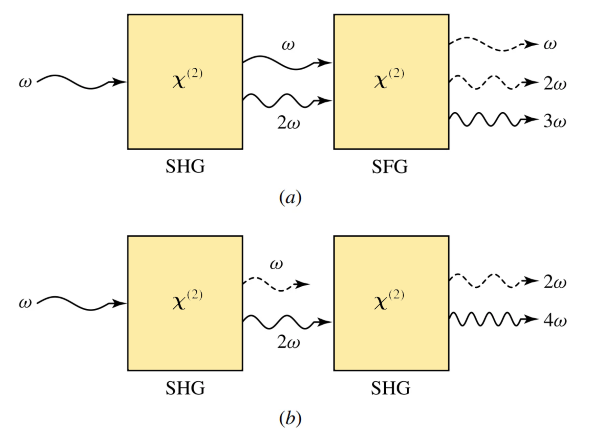
The above image illustrates two common arrangements of optical frequency conversion processes involving second-order nonlinear susceptibility χ(2).
In fig (a), the process begins with SHG, where a fundamental input at frequency ω enters a nonlinear medium and generates a second harmonic at 2ω. Both the original ω and generated 2ω beams then enter a second nonlinear crystal, where sum-frequency generation (SFG) occurs. In this process, the two frequencies combine to generate a new output at 3ω. As a result, three distinct frequencies - ω, 2ω, and 3ω - are present at the output.
In fig (b), a cascaded SHG configuration is shown. Again, the process begins with frequency ω, which undergoes SHG to produce 2ω. This newly generated second harmonic is then passed into another SHG crystal, where it is further doubled to yield a fourth harmonic at 4ω. This cascaded structure is a common technique to reach ultraviolet or even deep-UV wavelengths by sequentially doubling the frequency.
These illustrations emphasize how higher-order harmonics (e.g., 3ω, 4ω) can be generated by cascading multiple nonlinear processes and combining SHG with other methods like SFG. Each stage is governed by the conservation of energy and momentum (phase matching) within the nonlinear media.
More advanced converters use optical parametric oscillation. In this method, a single high-frequency laser beam is passed through a nonlinear crystal, where it splits into two lower-frequency beams, called the signal and idler. These frequencies can be widely tunable, offering great flexibility for research and development. Another technique, often used in fiber optics, is four-wave mixing, where interactions among multiple light waves in a nonlinear medium generate new frequencies.
To make these conversions work, optical frequency converters use specially engineered materials like beta barium borate (BBO), potassium titanyl phosphate (KTP), lithium niobate (LiNbO₃), or lithium triborate (LBO). These materials are chosen because of their transparency across wide wavelength ranges and their ability to support strong nonlinear interactions without degrading the beam quality.
These technologies find use across many fields. In laser engineering, they are essential for building sources of light in colors not directly available from lasers. In telecommunications, they enable signals to be shifted across different wavelength bands to make better use of fiber optic bandwidth. In spectroscopy and sensing, they provide access to infrared or ultraviolet light for analyzing chemical compositions. In biomedical imaging, frequency converters allow multiphoton microscopy and other nonlinear imaging techniques that can see deeper into tissues with higher contrast.
Optical frequency converters are critical components in modern photonics. By exploiting nonlinear interactions within specific crystals, they make it possible to produce a wide range of wavelengths from a limited set of laser sources. This frequency-shifting capability underpins many innovations in science, communications, medicine, and technology.
Click here to learn more about optical frequency converters.
Gophotonics has listed Optical Frequency Converters from the leading companies. Use the parametric search tool to find products based on your requirements.

