57 Wavefront Sensors
from
6 Manufacturers
57 Products
from
6 Manufacturers
Page 1 of 5
What is a Wavefront Sensor?
A wavefront sensor is a device used to measure an optical wavefront and detect any aberrations within it. A wavefront is a region where all points in the wave share the same phase at a given moment. The sensor primarily reconstructs the phase of the incoming optical field - typically by measuring its slopes or gradients. While intensity information can be inferred from the detected light, amplitude is not measured directly; the main function is phase reconstruction. The wavefront can be interpreted as a surface formed by light rays from a distant source. These sensors are commonly used to identify and correct distortions caused by light passing through individual optics, optical assemblies, or atmospheric conditions. They are valuable for characterizing optical surfaces, aligning assemblies, and improving overall optical system performance.
These instruments directly measure the wavefront, avoiding the need for interference between beams to reconstruct it. Many wavefront sensing techniques are interferometric (e.g., shearing interferometers, holographic methods), but the Shack-Hartmann sensor provides a direct slope measurement without beam interference. Unlike traditional methods that rely on interference patterns to infer wavefront properties, wavefront sensors directly capture both the phase and intensity of a wavefront. This allows for a more straightforward and accurate measurement, simplifying the process of characterizing optical systems.

Wavefronts are classified based on the shape they take as light propagates:
- Plane Wavefront: The wavefront is flat and occurs when light propagates parallel from a distant source or a laser.
- Spherical Wavefront: The wavefront forms concentric spheres, typically when light emanates from a point source.
- Cylindrical Wavefront: The wavefront is cylindrical, formed by light emitted from a line source.
- Distorted Wavefront: This occurs when light passes through a medium that distorts its shape, such as turbulent air or imperfect optical surfaces.
Working Principle of Wavefront Sensors
When a coherent light beam with a plane wavefront passes through a medium or reflects from a surface, its wavefront is altered by the characteristics of the medium or surface. These changes result in distortions from the ideal wavefront, known as wavefront aberrations. While such aberrations can cause a loss of information, they can also provide insights into the properties of the medium or surface. Measuring these distortions is crucial, and this is done using a wavefront sensor.
Types of Wavefront Sensors
Wavefront sensors are broadly classified into two categories - zonal and modal. In addition, interferometric approaches such as Lateral Shearing Interferometry (LSI) and Quadriwave Lateral Shearing Interferometry (QWLSI) are often considered distinct types because they rely on self-referenced interference rather than zonal subdivision or modal decomposition.
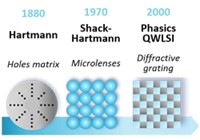
- Zonal Wavefront Sensors (e.g., Shack-Hartmann): These sensors divide the incoming wavefront into smaller zones or sub-apertures. The slope in each zone is measured individually, and the collective data is used to reconstruct the entire wavefront using mathematical algorithms. In a Shack-Hartmann sensor, the wavefront is divided using an array of microlenses. A collimated beam produces a grid of focal spots, which shift depending on the wavefront's distortion. The amount of shift helps determine the slope of each zone.
- Modal Wavefront Sensors: These sensors represent the wavefront as a combination of orthogonal aberration modes. They split the wavefront into two beams with identical characteristics and then pass each beam through different phase plates, applying positive and negative bias aberrations. The difference in intensity between the two beams at the detectors indicates the amount of the specific aberration present.
- Lateral Shearing Interferometry (LSI) Wavefront Sensors: A Lateral Shearing Interferometry (LSI) wavefront sensor measures distortions by comparing slightly displaced, self-referenced sections of an incoming wavefront. Unlike zonal and modal sensors that rely on segmented analysis or reference phase patterns, LSI uses interference patterns from sheared copies of the wavefront, offering a straightforward approach to assess errors. This method avoids the need for segmentation or modal decomposition and does not require a stable external reference, allowing for simpler configurations with fewer components. However, LSI sensors may be less sensitive to higher-order aberrations compared to modal sensors.
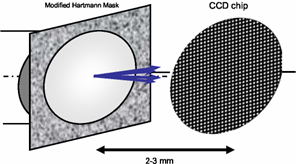
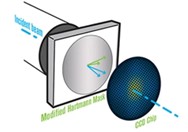
- Quadriwave Lateral Shearing Interferometry (QWLSI) Wavefront Sensors: The Quadriwave Lateral Shearing Interferometry (QWLSI) wavefront sensor is an advanced lateral shearing technique designed for high-resolution, sensitive wavefront distortion measurements. Using a specialized diffractive optical element, often a modified diffraction grating, QWLSI splits the incoming wavefront into four shifted copies, creating a quadrature pattern that captures complex wavefront shapes and phase variations. By combining lateral shearing with multi-directional analysis, QWLSI achieves high spatial resolution without lenslet arrays or phase plates, enabling robust detection of intricate wavefront distortions.
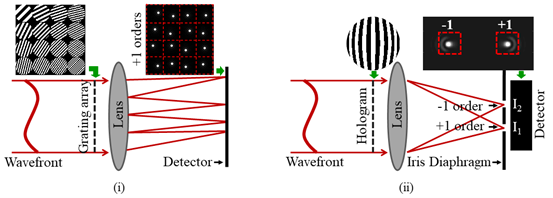
Both types of wavefront sensors, zonal and modal, can be implemented using binary holograms. In zonal sensors, an array of binary diffraction gratings replaces the lens array, producing an array of +1 diffraction orders at the focal plane of a lens. For modal sensors, the beam splitter and phase plates are substituted with a binary hologram, which generates +1 and -1 diffracted beams. These beams function as the positive and negative bias beams, respectively, allowing for precise wavefront measurement. Both sensor types are crucial for measuring and correcting wavefront distortions in various applications, such as adaptive optics and material characterization.
Applications of Wavefront Sensors
Wavefront sensors are widely used across optics and photonics, with core applications in optics testing, alignment, and laser beam characterization. In material inspection, they enable precise 3D surface topography measurements, optical waveguide metrology, index of refraction mapping, nanoplasmonics and photothermal imaging, as well as Laser-Induced Damage Threshold (LIDT) monitoring. They are also essential in adaptive optics control, where they help optimize and shape laser beams, precisely control focal spot size, and adjust the three-dimensional position of focal points. In optical components quality control, wavefront sensors are used to evaluate key performance parameters such as wavefront error, Modulation Transfer Function (MTF), and critical lens characteristics, ensuring high optical quality and system reliability.
In imaging and system-level applications, wavefront sensors play a vital role in quantitative phase imaging by enabling instantaneous retrieval of both intensity and phase information. This capability allows label-free imaging of large populations of living cells at the single-cell level, providing quantitative data on cell morphology, dry mass, density, homogeneity, and protein distribution, which is crucial for cancer research, pharmacology, microbiology, blood analysis, stem cell studies, and quantitative phase tomography. Additionally, wavefront sensors are extensively used in optical systems alignment and testing, supporting automatic alignment of focusing optics and toroidal mirrors, correction of telescope aberrations, optimization of active optics, and characterization of diagnostic beamlines. They are also employed in source characterization, offering real-time monitoring of optical quality at various points in an optical setup, such as after a monochromator, optical elements, or a sample while tracking focal spot stability and positional fluctuations.

