50 Photoconductive Antenna
from
5 Manufacturers
50 Products
from
5 Manufacturers
Page 1 of 5
What is a Photoconductive Antenna (PCA)?
A Photoconductive Antenna (PCA) is a semiconductor-based device that generates or detects terahertz (THz) radiation by converting ultrafast optical pulses into electrical currents. PCAs play a central role in THz time domain spectroscopy and imaging systems because they provide efficient broadband THz emission and coherent detection. Each device consists of a highly resistive semiconductor thin film, usually low-temperature-grown GaAs or InGaAs, along with metallic electrodes that form a small dipole structure. When illuminated by a sub-picosecond laser pulse, the photoconductive layer becomes momentarily conductive, creating a short transient current that emits electromagnetic radiation in the THz region.
Construction of a Photoconductive Antenna
A photoconductive antenna is fabricated by depositing a thin photoconductive semiconductor layer, such as low-temperature-grown GaAs or ion-implanted GaAs, onto a semi-insulating GaAs substrate. The has a carrier lifetime of around 20 picoseconds, while the intentionally defect-rich photoconductive layer is engineered to have ultrafast carrier lifetimes shorter than 1 picosecond. These short lifetimes are essential because they allow the PCA to generate extremely fast electrical transients, which directly determine the bandwidth of the emitted THz pulse.
To achieve such rapid recombination, the film incorporates controlled crystal defects created either through ion implantation or by growing the material at low temperatures. These defects introduce deep trap states within the semiconductor bandgap, enabling fast non-radiative recombination of photoexcited electron–hole pairs. As a result, the film becomes conductive only for a sub-picosecond interval when illuminated by an ultrafast laser pulse, allowing the PCA to operate as an efficient broadband THz emitter or detector.
Metallic electrodes patterned on the surface define the antenna geometry, including the dipole gap and antenna arm length, which govern resonance behaviour and coupling efficiency. Additional components, such as hyperhemispherical or elliptical silicon lenses may be attached to enhance THz beam extraction and focusing. Together, the engineered semiconductor layer, electrode design, and lens coupling optimize the PCA for high-power, broadband terahertz performance.
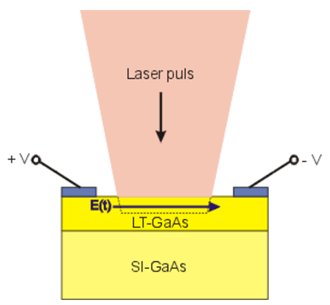
Fig: Photoconductive Antenna
Working Principle of a Photoconductive Antenna
When a femtosecond laser pulse is focused onto the PCA gap, photons with energy greater than the semiconductor bandgap are absorbed and generate electron hole pairs. These carriers exist only for a very short time before recombining through defect states. In transmitter mode, an applied bias accelerates the carriers during the optical pulse, producing a rapid transient current that emits a broadband THz pulse. In receiver mode, the incoming THz field accelerates the photoexcited carriers at the moment of optical gating, producing a measurable voltage signal that represents the instantaneous THz electric field. Since the emitted wavelengths are much longer than the dipole size, the resulting THz radiation diffracts widely and forms a broad emission cone.
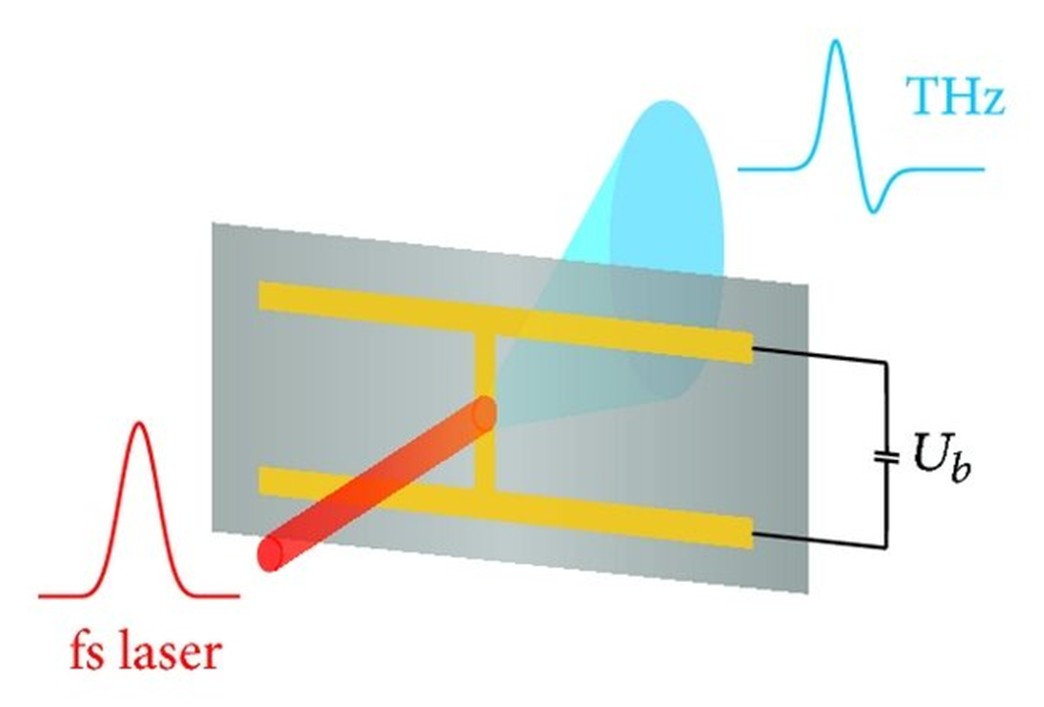
Fig: Working principle of PCA
Types of Photoconductive Antennas (PCAs)
- Dipole PCAs: The simplest and most widely used PCA design, consisting of two linear metal electrodes separated by a small gap. Their resonance frequency is determined by the dipole length, making them suitable for broadband THz generation and detection.
- Bowtie PCAs: These use a V-shaped electrode geometry that increases bandwidth and improves field enhancement within the excitation gap. Bowtie PCAs are commonly used in pulsed THz systems where broad spectral coverage is required.
- Stripline PCAs: A planar structure with parallel metal strips on a dielectric substrate. Stripline PCAs offer stable THz performance, simple fabrication and are often used in standard THz-TDS setups.
- Spiral PCAs: Designed with interleaving spiral electrodes to achieve ultrabroadband operation. Their frequency-independent geometry makes them ideal for applications requiring wide spectral response or circular polarization.
- PCA Arrays: Composed of multiple PCA elements combined to increase output power, improve beam directionality or enhance signal-to-noise ratio. Array PCAs are used in high-power THz imaging, spectroscopy and advanced communication systems.
Applications of Photoconductive Antennas
PCAs are widely used in broadband THz spectroscopy where they act as both emitters and detectors. Their ability to generate coherent THz pulses allows detailed analysis of material properties, molecular vibrations and low energy excitations. Since THz waves penetrate materials like paper and plastic, reflect from metals and are absorbed by specific molecular resonances, PCAs are ideal for nondestructive testing and chemical identification.
In industrial environments, PCAs support polymer inspection, packaged IC evaluation, drug polymorph analysis, food quality monitoring and process control. They are also used in scientific research for studying semiconductor dynamics, advanced materials and ultrafast processes.
THz systems equipped with PCAs are useful in security applications, including luggage screening, mail inspection, detection of concealed items and reading information hidden under surfaces. Because THz radiation is nonionizing, PCA-based systems provide safe inspection capabilities for both people and materials.
Gophotonics has listed Photoconductive Antennas from the leading companies. Use the parametric search tool to find products based on your requirements.

