93 Polarimeters
from
23 Manufacturers
93 Products
from
23 Manufacturers
Page 1 of 9
What is a Polarimeter?
A polarimeter is a precision optical instrument designed to measure the angle of rotation of linearly polarized light as it passes through an optically active substance. This phenomenon, known as optical rotation, occurs when chiral molecules—such as sugars, amino acids, or other organic compounds—interact with polarized light, altering its plane of polarization. By quantifying this rotation, polarimeters provide valuable information about the concentration, purity, and stereochemical properties of substances, making them indispensable in fields such as chemistry, pharmaceuticals, food processing, and quality control.
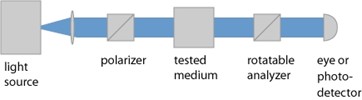
Working Principle of a Polarimeter:
The working principle of a polarimeter is based on optical rotation, a phenomenon in which polarized light interacts with an optically active substance and undergoes a change in the orientation of its polarization plane. The process begins with light from a source such as a laser, LED, or incandescent lamp, which is passed through a polarizer. This polarizer restricts the light waves so that they oscillate in a single plane, producing linearly polarized light. The degree of polarization and the wavelength of the light are important, as they directly influence the accuracy of the measurement.
The linearly polarized light is then directed through a sample tube containing an optically active substance. Such substances, typically composed of chiral molecules like sugars or amino acids, have the ability to rotate the plane of polarized light, a behavior known as optical rotation. As the light travels through the sample, the extent of this rotation depends on several factors, including the concentration of the substance, the length of the sample tube, and the wavelength of the light used. Higher concentrations and longer optical paths lead to larger rotation angles, while different wavelengths can produce different degrees of rotation for the same material.
After passing through the sample, the rotated polarized light reaches the analyzer, which functions as a second polarizer. The analyzer is rotated until it aligns with the new polarization direction of the light. By adjusting the analyzer and observing the changes in transmitted light intensity, the angle of optical rotation can be determined, typically by identifying the positions where the transmitted intensity is at a minimum or maximum.
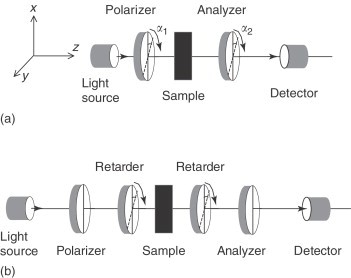
Components of a Polarimeter:
Light Source: The light source is fundamental in providing a stable beam of light for polarization. Different types of light sources are used, such as lasers (which provide coherent, monochromatic light), LEDs, or incandescent lamps. For accurate measurements, the light source's stability and bandwidth must be considered since the degree of optical rotation may vary across different wavelengths.
Polarizer: The polarizer is responsible for transforming the unpolarized light from the source into linearly polarized light. It ensures that all light waves oscillate in the same plane. Common types of polarizers include Nicol prisms and polarizing filters. The polarizer's precision in generating perfectly aligned polarized light is crucial for accurate measurements.
Sample Tube: This component holds the optically active substance and is typically made of transparent materials like glass. The sample tube's length is an important variable, as it influences the total optical rotation. Longer tubes allow light to interact more extensively with the optically active substance, resulting in a more significant rotation of the polarization plane.
Analyzer: The analyzer is another polarizing filter placed after the sample tube. Its role is to detect the rotated light by allowing only light waves oscillating in a specific plane to pass through. By rotating the analyzer, the operator can measure the angle at which the transmitted light reaches its minimum (or maximum) intensity, which corresponds to the degree of rotation caused by the sample.
Detector: The detector measures the intensity of light passing through the analyzer. It helps determine the exact point where the analyzer is aligned with the rotated polarization plane. In automated polarimeters, detectors are coupled with electronic systems to automatically calculate the angle of rotation, reducing the chance of human error and improving measurement precision.
Types of Polarimeters:
Polarimeters come in various types, each tailored to specific applications, ranging from basic laboratory setups to advanced industrial devices. Here are the main types of polarimeters:
- Simple Polarimeters: Simple polarimeters are the most basic and often used for educational purposes or introductory experiments. They consist of a light source, polarizer, sample tube, and analyzer, requiring manual adjustments to measure the angle of rotation. Though they lack advanced features, simple polarimeters are effective for teaching the fundamental concepts of optical rotation.
- Manual Polarimeters: Manual polarimeters are more sophisticated and are widely used in research and industrial settings. They rely on the user to manually rotate the analyzer to measure the angle of rotation. These polarimeters often include precision scales (such as Vernier or circular scales) for highly accurate readings. Despite the manual operation, they offer reliable performance for detailed scientific studies.
- Automatic Polarimeters: Automatic polarimeters have gained popularity due to their efficiency and ease of use. These devices automate the process of rotating the analyzer and determining the angle of optical rotation. With a high degree of accuracy, automatic polarimeters reduce human error and are well-suited for high-throughput environments. They are often used in industries such as pharmaceuticals, where frequent and precise measurements are required.
- Digital Polarimeters: Digital polarimeters incorporate advanced electronics for automatic angle determination and data acquisition. Equipped with digital displays, microprocessors, and data storage capabilities, these devices offer faster and more consistent results than their manual counterparts. They are ideal for applications requiring high precision and repeatability, such as pharmaceutical quality control and chemical analysis.
- In-line and Process Polarimeters: These polarimeters are integrated into industrial production lines to provide continuous, real-time measurements. In-line and process polarimeters monitor the optical activity of substances during manufacturing processes, making them essential for quality control in industries like food and beverages, chemicals, and pharmaceuticals. They allow operators to adjust processes on the fly based on real-time data.
- Multi-Wavelength Polarimeters: Some substances exhibit varying degrees of optical rotation at different wavelengths. Multi-wavelength polarimeters can measure optical rotation across multiple wavelengths, enhancing the specificity and accuracy of polarimetric analysis. These instruments are especially useful in complex mixtures where different compounds may contribute differently to the observed optical rotation.
- Ellipsometers: While not strictly polarimeters, ellipsometers are closely related instruments that measure changes in the polarization state of light reflected from a sample surface. They are widely used to study thin films and surfaces, particularly for determining layer thickness and optical constants. As a related technique, ellipsometry complements polarimetric measurements by providing additional insight into a material’s optical properties, especially at interfaces and surfaces.
Applications of Polarimeters:
In scientific research and industrial analysis, polarimetry is used to determine the magnitude of optical activity in substances containing chiral molecules. By measuring the rotation of polarized light as it passes through a sample, this technique enables accurate characterization of optically active materials.
For concentration measurements, the measured angle of polarization rotation can be used when the specific rotation of a substance is already known. In such cases, the degree of optical activity provides a direct means of determining the concentration of that substance in a solution.
A well-established application is the measurement of sugar concentration in liquids, which is widely used in the sugar industry and in wine production. Instruments designed for this purpose, commonly known as saccharimeters, enable fast and accurate determination of sugar content in aqueous solutions.
In samples containing mixtures of enantiomers, optical activity measurements allow determination of the relative proportions of mirror-image molecular forms. Because the polarization rotations from different enantiomers add algebraically, this method can be used to analyze enantiomeric composition, including cases where the net rotation approaches zero.
In chemical and biological contexts, polarimetric measurements are primarily used to determine the concentration of that optically active form, relying on its characteristic polarization rotation.
Gophotonics has listed Polarimeters from the leading companies. Use the parametric search tool to find products based on your requirements.

