244 Acousto-Optic Frequency Shifters
from
12 Manufacturers
244 Products
from
12 Manufacturers
Page 1 of 24
What are Acousto-Optic Frequency Shifters?
Acousto-Optic Frequency Shifters (AOFS) are optical devices that change the frequency of a laser beam by utilizing the interaction of light and sound waves in a crystal. The frequency shift occurs due to the Doppler effect, as light interacts with a moving refractive index grating formed by acoustic waves. This grating is created by sound waves propagating through the medium, periodically altering its refractive index.
The Doppler effect arises because the refractive index grating moves through the medium at the speed of sound. As light interacts with this moving grating, its frequency shifts depending on the direction of the grating’s motion relative to the light. A grating moving against the light increases the frequency (up-shift), while motion in the same direction decreases it (down-shift). The frequency shift equals the frequency of the acoustic wave, enabling precise modulation of the light. This technology finds applications in laser modulation, interferometry, and signal processing, where precision is essential.
Principle of Operation
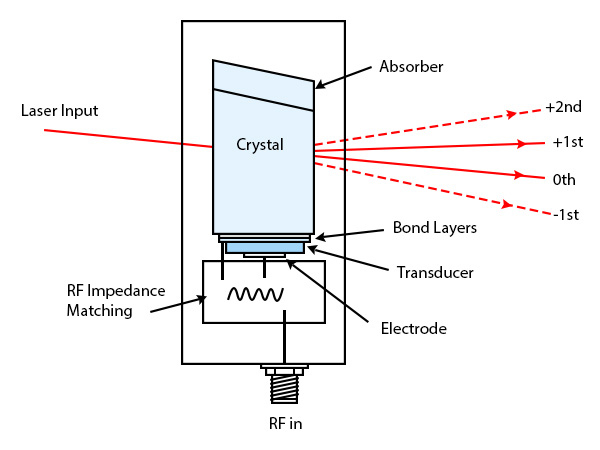
Acousto-optic frequency shifters operate on the principle of light diffraction within a medium that contains a moving refractive index grating. This grating is generated using acoustic waves, which propagate through a crystal medium. The interaction between light and the dynamic refractive index results in a frequency shift in the diffracted light beam, either increasing or decreasing its frequency by an amount equal to the acoustic frequency.
The functionality of AOFS relies on two interrelated phenomena: the generation of acoustic waves and the diffraction of light.
- Acoustic Wave Generation: Acoustic waves are generated using a piezoelectric transducer attached to the surface of a crystal. When an RF (radio frequency) signal is applied to the transducer, it induces mechanical vibrations within the crystal, creating an acoustic wave. These waves propagate through the material, producing alternating regions of compression and rarefaction. These periodic density changes alter the refractive index of the material in a spatially periodic pattern, forming a moving refractive index grating.
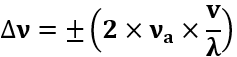
- Light Diffraction and Frequency Shift: When a laser beam enters the crystal, it interacts with the refractive index grating. Under Bragg's diffraction condition, a portion of the light is diffracted. The frequency of the diffracted light shifts depending on the relative motion of the refractive index grating. The frequency shift, Δν, is given by:
Where:
νa is the acoustic wave frequency.
v is the velocity of the acoustic wave in the crystal.
λ is the wavelength of the incident light.
The ± sign indicates a positive or negative frequency shift.
This mechanism allows precise control over the frequency of the laser beam.
Components of AOFS
- Piezoelectric Transducer: This component converts the applied RF signal into mechanical vibrations. Materials like quartz or lead zirconate titanate are commonly used for their high piezoelectric efficiency.
- Acousto-Optic Crystal: The crystal serves as the medium for acoustic and optical interaction. Tellurium dioxide (TeO₂) and silica are frequently chosen for their favorable optical and acoustic properties.
- RF Driver: The RF driver provides the electrical signal that controls the transducer. It may operate at a fixed or variable frequency. Drivers can include:
- Voltage-Controlled Oscillators (VCO): Allowing analog control of the drive frequency.
- Digital Drivers: Offering high precision and stability for demanding applications.
- Optical Coupling Elements: Collimators and lenses are used to ensure the input laser beam is correctly aligned and focused through the crystal, optimizing diffraction efficiency.
Advanced Configurations
- Cascaded AOFS: For larger frequency shifts or precise small shifts (e.g., a few MHz), multiple AOFS devices can be used in sequence.
- Double-Pass Configuration: In a double-pass arrangement, light passes through the AOFS twice, effectively doubling the frequency shift. This configuration is used to achieve higher frequency offsets while maintaining compact setups.
- Fiber-Coupled AOFS: Compact fiber-pigtailed AOFS integrate seamlessly into optical fiber systems, where light is collimated, modulated, and refocused into the output fiber. All-fiber AOFS, though less common, achieve frequency shifts directly within an optical fiber medium.
Applications of Acousto-Optic Frequency Shifters
Acousto-optic frequency shifters (AOFS) play a key role in both industrial and scientific optical systems by enabling precise and controlled frequency modulation of laser beams. In industrial environments, they support high-accuracy motion and vibration analysis by introducing a controlled frequency offset that improves directional discrimination and measurement sensitivity. Their ability to dynamically manipulate laser beam characteristics also makes them valuable in automated and precision-controlled optical setups, where accurate timing and beam management are essential.
In research and laboratory settings, AOFS devices are widely used to generate stable frequency offsets between optical signals, facilitating highly sensitive measurements of phase, frequency, and displacement. By introducing a controlled shift within optical paths, they enhance measurement precision in interferometric arrangements and enable fine spectral analysis without the need for complex laser tuning mechanisms. This capability allows researchers to achieve improved resolution, reduced noise, and greater flexibility in advanced optical measurement systems.
Gophotonics has listed Acousto-Optic Frequency Shifters from the leading companies. Use the parametric search tool to find products based on your requirements.

