What is an LED Driver IC?
An LED Driver IC is an integrated circuit designed to regulate and supply a stable current or voltage to an LED (Light Emitting Diode) or an array of LEDs. These ICs ensure that LEDs receive the appropriate electrical power for optimal performance, preventing overdriving or underdriving, which can affect efficiency and lifespan.
LEDs, which are semiconductors that emit light when current flows through them, operate on low DC voltage and are current-driven. Unlike incandescent bulbs, they require precise electrical control. Variations in current can lead to flickering, overheating, reduced brightness, and shorter lifespan. LED Driver ICs regulate this power, ensuring safe operation, higher energy efficiency, and longer life. They also offer advanced features such as dimming and color control.
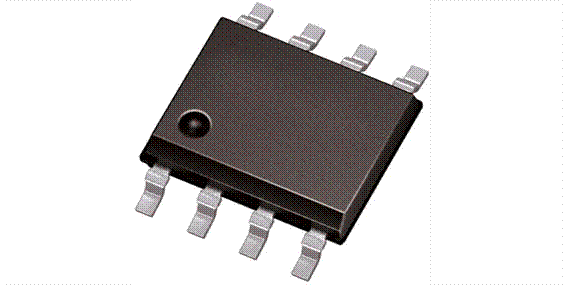
These LED Driver ICs manage electrical power by converting AC or DC input into a regulated output tailored to the LED system's needs, whether constant current or constant voltage. By controlling the current, the driver prevents excess current that could degrade LED performance.
Working Principle of LED Driver ICs
LED driver ICs operate on a closed-loop control principle to deliver a stable and controlled output - typically constant current - to LEDs. Since LED brightness and lifetime are highly dependent on current, the driver IC continuously regulates the output to maintain a fixed operating point regardless of input voltage variations or load changes.
The process begins with the input stage, where the IC accepts power from an AC or DC source. If the input is AC, it is first rectified and filtered to produce a DC voltage. This DC is then processed by a regulation stage, usually based on a switching converter (such as buck, boost, or buck-boost topology), which efficiently adjusts the voltage and current to match the LED requirements.
The defining feature of the driver IC is its feedback loop. The output current (or voltage, in constant-voltage designs) is continuously sensed and compared with an internal reference. Any deviation is corrected by adjusting the duty cycle of the switching element, ensuring that the output remains constant even under fluctuations in supply or load conditions.
Additionally, integrated protection and thermal management circuits monitor operating conditions in real time. Features such as overcurrent protection, overvoltage protection, and thermal shutdown safeguard both the LEDs and the driver, ensuring reliable and long-term operation.
Components of LED Driver ICs
The main components within an LED Driver IC include:
1. Rectifiers: Rectifiers convert alternating current (AC) to direct current (DC), essential for LEDs powered by AC sources like standard outlets. This stable DC output is necessary because LEDs operate only on DC power.
2. Switching Regulators: Switching regulators use rapid on-off cycles to maintain the desired current or voltage for LEDs, enabling efficient power conversion. This switching minimizes power loss, making these regulators well-suited for high-power and battery-operated systems.
3. Current Sensing Resistor: A current sensing resistor monitors the actual current passing through the LEDs, providing feedback to adjust it as needed. This feedback loop helps protect LEDs from damage due to excessive current.
4. Pulse Width Modulation (PWM) Controller: The PWM controller regulates LED brightness by adjusting the on-off duty cycle of the current. By controlling how long the LEDs stay on, the PWM provides efficient dimming without altering the current's magnitude.
5. Thermal Protection Circuit: This circuit safeguards the system against overheating. When temperatures exceed safe limits, it reduces or shuts off power to prevent thermal damage, extending the lifespan of both LEDs and the driver.
6. Inductors and Capacitors: Inductors and capacitors smooth the power output, reducing noise and current ripple. Inductors handle sudden current changes, while capacitors maintain a steady voltage, ensuring stable LED performance and reducing flicker.
Applications of LED Driver ICs
LED driver ICs are primarily used in general lighting systems, where they regulate current to ensure stable brightness and improved energy efficiency in residential, commercial, and industrial lighting applications. Their ability to provide precise current control makes them essential for extending LED lifespan and maintaining consistent illumination.
In display backlighting, LED driver ICs are used to control the brightness of LEDs in devices such as smartphones, televisions, and laptops. They ensure uniform light distribution and enable features like dimming and brightness adjustment, contributing to better display quality and power management.
In automotive systems, LED driver ICs are integral to the operation of headlights, taillights, and interior lighting. They provide reliable performance under fluctuating voltage conditions and extreme temperatures, ensuring consistent light output and compliance with safety standards.
LED driver ICs are also widely used in smart lighting systems, where they enable advanced functionalities such as dimming control, color tuning, and integration with wireless communication and IoT platforms. This allows for intelligent lighting control and improved energy savings.
Additionally, in street and outdoor lighting, LED driver ICs ensure efficient and long-lasting operation of streetlights and public infrastructure lighting. They help maintain stable performance over long periods while minimizing energy consumption and maintenance requirements.
Gophotonics has listed LED Driver ICs from the leading companies. Use the parametric search tool to find products based on your requirements.

