25 Acousto-Optic Mode Lockers
from
5 Manufacturers
25 Products
from
5 Manufacturers
Page 1 of 2
What are Acousto-optic mode lockers (AOMLs)?
Acousto-optic mode lockers (AOMLs) are optical devices designed to achieve ultrashort laser pulses of extremely high intensity. They operate on the principle of acousto-optic interactions, which allow precise control over the temporal properties of the laser beam. These characteristics make AOMLs indispensable tools in various advanced scientific, industrial, and medical applications, such as spectroscopy, medical diagnostics, telecommunications, and material processing.
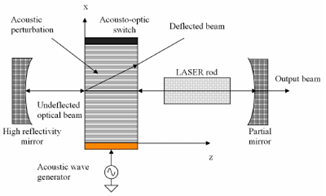
Principles of Operation of Acousto-Optic Mode Locker
The function of an acousto-optic mode locker is to modulate optical losses within a laser cavity at its resonant frequency. This is accomplished using an acousto-optic modulator (AOM), which generates an acoustic wave that creates periodic variations in the refractive index of the medium. These variations act as a dynamic diffraction grating, interacting with the circulating laser beam to selectively control its intensity. By tuning the modulation to match the cavity’s natural frequency, the phases of longitudinal modes are synchronized, resulting in stable ultrashort pulse generation.
The AOM operates by generating an acoustic wave driven by an external radio-frequency (RF) signal. As this wave propagates through the medium, it induces periodic refractive index changes via the photoelastic effect, effectively creating a dynamic diffraction grating. When the laser beam interacts with this grating, specific frequency components of the laser experience selective modulation, leading to phase synchronization of the laser’s longitudinal modes.
By tuning the RF frequency to match the resonant frequency of the laser cavity, the AOM ensures phase synchronization of different longitudinal modes. This synchronization forces the modes to oscillate coherently and converts continuous-wave operation into a sequence of ultrashort pulses.
The mode-locking process in an acousto-optic mode locker consists of four key steps, each playing a crucial role in converting continuous-wave laser operation into a train of ultrashort pulses. The processes include:
- Acoustic Wave Generation: The process begins when an RF driver excites an acousto-optic modulator (AOM) by generating a radio-frequency signal. This signal reaches a piezoelectric transducer attached to the AOM medium, typically quartz or tellurium dioxide. The transducer converts the RF signal into mechanical vibrations and produces an acoustic wave that propagates through the medium. The RF signal controls the frequency and amplitude of the wave, which enables precise modulation of the intracavity laser beam.
- Dynamic Grating Formation: As the acoustic wave moves through the AOM medium, it induces periodic changes in the refractive index due to the photoelastic effect. This creates a moving diffraction grating that interacts with the circulating laser beam. Some portions of the beam are diffracted, while others remain unaffected. The efficiency of this diffraction depends on the strength of the acoustic wave, which can be adjusted via the RF signal. This dynamic grating modulates the optical losses within the cavity, a key step in synchronizing the laser’s longitudinal modes.
- Phase Locking: In an unmodulated laser cavity, multiple longitudinal modes oscillate independently. Mode locking forces these modes into a fixed phase relationship, which enables them to interfere constructively. This occurs when the RF frequency applied to the AOM matches the natural mode spacing of the laser cavity, given by:
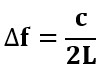
where c is the speed of light and L is the cavity length. The periodic loss modulation selectively enhances in-phase modes while suppressing others, leading to coherent oscillation.
- Pulse Generation:Once phase locking is established, the superposition of synchronized modes results in the formation of a periodic pulse train instead of continuous-wave emission. These pulses exhibit:
- Ultrashort Duration: More phase-locked modes lead to shorter pulses.
- High Peak Intensity: Concentrating energy into short bursts increases peak power.
- Fixed Repetition Rate: The pulse train repeats at the inverse of the cavity round-trip time.
This controlled process enables stable ultrashort pulse generation for applications requiring high precision and intensity.
Key Components of Acousto-Optic Mode Lockers
Acousto-optic mode lockers (AOMLs) rely on precisely engineered components to generate ultrashort, high-intensity laser pulses. The three fundamental components-the acousto-optic modulator (AOM), the RF driver, and the laser cavity-work together to achieve stable mode locking by selectively modulating intracavity losses.
Acousto-Optic Modulator (AOM)
The acousto-optic modulator is the core element that creates a dynamic diffraction grating within the laser cavity. It consists of an optically transparent medium, such as quartz, tellurium dioxide (TeO₂), or fused silica, selected for its ability to transmit both optical and acoustic waves efficiently. The material must exhibit strong photoelastic properties to induce periodic refractive index variations in response to an applied acoustic wave.
When the RF driver applies an oscillating signal, the AOM generates an acoustic wave that propagates through the medium. This wave causes periodic density fluctuations, which alter the refractive index and form a moving diffraction grating. As the laser beam passes through the modulator, it undergoes time-dependent diffraction, introducing controlled loss modulation within the cavity. Precise adjustment of the RF signal to match the cavity’s fundamental frequency ensures synchronization of longitudinal laser modes, which establishes stable mode locking.
RF Driver
The RF driver powers the AOM and determines the frequency and amplitude of the acoustic wave. It generates a radio-frequency (RF) signal-typically in the range of tens to hundreds of megahertz (MHz)-that excites a piezoelectric transducer attached to the AOM medium. This transducer converts the electrical RF signal into mechanical vibrations, producing the traveling acoustic wave inside the modulator.
For effective mode locking, the RF frequency must precisely match the round-trip frequency of the laser cavity, ensuring that the modulation synchronizes with the circulating optical wave. The RF driver also controls modulation depth, which influences pulse formation and stability. A higher modulation depth enhances mode-locking efficiency by introducing stronger loss variations, improving the coherence of ultrashort pulse generation.
Laser Cavity
The laser cavity provides the optical feedback necessary for sustained laser oscillation. It consists of a gain medium, responsible for light amplification, and highly reflective mirrors that guide the beam through multiple passes to build up intensity.
- Gain Medium: This material amplifies light through stimulated emission, converting external pump energy into coherent laser output. The choice of gain medium, such as Ti:Sapphire, Nd:YAG, or ytterbium-doped fiber, determines the laser’s wavelength, gain bandwidth, and achievable pulse duration.
- Reflective Mirrors: A typical laser cavity includes a highly reflective rear mirror and a partially transmitting output coupler, which extracts a portion of the laser beam while maintaining enough intracavity power for continuous oscillation.
- Cavity Length: The optical path length of the cavity directly influences the repetition rate of generated pulses. Shorter cavities produce higher repetition rates, while longer cavities allow lower-frequency pulse trains.
When mode locking is active, the AOM dynamically modulates intracavity losses at a frequency matching the cavity’s natural oscillation. This synchronization forces the laser’s longitudinal modes into phase coherence, leading to the formation of stable, ultrashort pulses rather than continuous-wave output.
Parameters of Acousto-Optic Mode-Locked Lasers
- Pulse Duration: AOMLs are capable of producing ultrashort pulses ranging from picoseconds (10⁻¹² seconds) to femtoseconds (10⁻¹⁵ seconds). The exact duration depends on the laser configuration and the precision of the mode-locking process.
- Repetition Rate: The pulse repetition rate is directly tied to the round-trip time of the light within the laser cavity, which is determined by the cavity length and the modulation frequency of the AOM.
- Pulse Energy: The energy per pulse is influenced by factors such as the laser gain medium, pump power, and cavity design. Proper alignment and optimization of the AOM ensure efficient energy conversion into ultrashort pulses.
Applications of Acousto-Optic Mode Lockers
- Spectroscopy: AOMLs enable time-resolved spectroscopy, providing ultrashort pulses for studying molecular and atomic dynamics. These pulses track rapid electronic transitions, molecular vibrations, and chemical reactions with high temporal resolution. Techniques like pump-probe spectroscopy and coherent Raman spectroscopy benefit from precise pulse synchronization, improving spectral resolution and detection sensitivity.
- Biomedical Imaging: Ultrashort pulses from AOMLs enhance multiphoton microscopy and optical coherence tomography. Multiphoton microscopy excites fluorophores using simultaneous low-energy photons, allowing deep tissue imaging with minimal photodamage. Optical coherence tomography improves axial resolution and penetration depth, making it useful in ophthalmology, cardiology, and dermatology for high-precision diagnostic imaging.
- Material Processing: AOMLs enable high-precision laser micromachining, minimizing thermal damage by confining energy to ultrashort pulse durations. These pulses allow controlled material removal, improving micro-drilling, surface structuring, and laser ablation in semiconductor fabrication and medical device manufacturing. Their ability to modify material properties without excessive heat makes them ideal for delicate materials.
- Telecommunications: AOMLs generate precisely timed optical pulses for high-speed data transmission in fiber-optic networks. Their role in optical frequency comb generation and time-division multiplexing ensures stable signal encoding and enhanced bandwidth utilization. High pulse stability and tunability make them essential for next-generation optical communication systems.
Gophotonics has listed Acousto-Optic Mode Lockers from the leading companies. Use the parametric search tool to find products based on your requirements.

