305 Photoresistors
from
4 Manufacturers
305 Products
from
4 Manufacturers
Page 1 of 30
What are Photoresistors?
Photoresistors, also known as light-dependent resistors (LDRs), are passive components whose resistance decreases as the intensity of incident light increases. Unlike photodiodes or photovoltaic cells, they do not generate an electrical signal on their own; instead, their changing resistance can be used within a circuit to produce a varying voltage or current. This property makes them useful in applications such as automatic lighting systems, light meters, and alarm systems.
Photoresistors play a crucial role in detecting and measuring changes in light intensity, allowing devices to be automatically controlled based on ambient light levels. This functionality is key in applications like street lighting, where lights automatically switch on or off depending on the surrounding brightness.
Working Principle of Photoresistors
The working of photoresistors is based on the phenomenon of photoconductivity, where the material's conductivity increases as light falls on it. This happens due to the energy carried by photons (light particles) being absorbed by the semiconductor material of the photoresistor, typically cadmium sulfide (CdS). The absorption of light energy excites electrons in the material, increasing the number of free electrons available for conduction, as shown in the second diagram. When more electrons are available, the resistance of the material decreases.
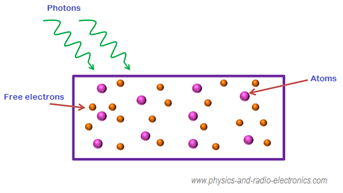
In darkness, the resistance is very high as fewer electrons are excited. When exposed to light, the number of excited electrons increases, reducing the resistance significantly.
Components and Structure
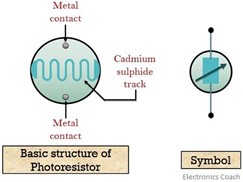
As seen in the first diagram, the basic structure of a photoresistor includes:
- Cadmium Sulfide (CdS) Track: The core of the photoresistor is the Cadmium Sulfide (CdS) track. This material reacts to light by changing its resistance. In low light conditions, the resistance is high, but when exposed to light, it drops, allowing more current to pass through. This change in resistance makes it ideal for light sensing applications.
- Metal Contacts: Metal contacts are attached to either end of the CdS track. These contacts allow the photoresistor to be connected to an electrical circuit, enabling it to function as a variable resistor in response to light levels. The metal contacts ensure that the changes in resistance are detected and can be used in various devices.
- Symbol: In circuit diagrams, the photoresistor is represented by a circle with an arrow pointing toward it. The arrow indicates the direction of light, and the circle represents the resistor itself. This symbol makes it easy to identify the photoresistor in schematics.
This simple structure makes photoresistors easy to integrate into circuits where light detection is needed.
When the photoresistor is exposed to light, photons strike the cadmium sulfide layer. These photons transfer energy to the electrons, freeing them from their atoms, which increases the number of charge carriers in the material (as shown in the second image). This increase in free electrons decreases the resistance of the photoresistor, allowing more current to pass through. In the absence of light, the material’s resistance is high due to the lack of free electrons.
Disadvantages of Photoresistors
- Slow Response Time: Photoresistors, especially those made from CdS, have slower response times compared to other light sensors like photodiodes or phototransistors, typically ranging from 10 ms up to over 1 s. This makes them suitable for applications such as lighting control but unsuitable for high-speed optical detection.
- Temperature Sensitivity: Their performance can be affected by temperature changes, potentially causing inaccuracies in varying environments.
- Environmental Concerns: The use of cadmium in some photoresistors raises environmental and health concerns, since CdS contains cadmium, a toxic heavy metal. As a result, CdS-based LDRs are being phased out or restricted by environmental regulations (e.g., RoHS directives in the EU), limiting their use in certain applications.
Applications of Photoresistors
In automatic street lighting systems, photoresistors continuously monitor ambient light levels. As daylight decreases at dusk, the resistance of the photoresistor increases, triggering the control circuit to switch the streetlights on. At dawn, increasing light intensity lowers the resistance, turning the lights off. This automation reduces energy consumption, eliminates the need for manual control, and ensures consistent operation under changing environmental conditions.
In camera light meters, photoresistors are used to sense scene brightness and convert it into an electrical signal that helps determine appropriate exposure settings. By measuring the amount of available light, the system can automatically adjust parameters such as aperture, shutter speed, or ISO to produce well-exposed images. While modern cameras often use more advanced sensors, photoresistors remain relevant in simple or educational imaging systems.
Within alarm and security systems, photoresistors function as light interruption or intrusion detectors. When a steady light beam is directed at the sensor, any obstruction—such as a person passing through—causes a sudden change in resistance. This change is detected by the control circuitry, triggering alarms or alerts. Such systems are commonly used in basic perimeter security, door sensors, and object detection setups.
In solar tracking systems, photoresistors are arranged to compare light intensity from different directions. By identifying where sunlight is strongest, the control system adjusts the orientation of solar panels to follow the sun’s movement throughout the day. This improves energy efficiency by maximizing solar exposure and increasing overall power output, particularly in small to medium-scale solar installations.
Gophotonics has listed Photoresistors from the leading companies. Use the parametric search tool to find products based on your requirements.

