68 Dispersion Compensation Modules
from
11 Manufacturers
68 Products
from
11 Manufacturers
Page 1 of 6
What are Dispersion Compensation Modules (DCMs)?
Dispersion Compensation Modules (DCMs), also referred to as Dispersion Compensation Units (DCUs), are pivotal in modern optical fiber communication systems. Their primary function is to mitigate chromatic dispersion, a phenomenon where varying wavelengths of light travel at different speeds through optical fibers, resulting in signal distortion and degradation. By effectively addressing chromatic dispersion, DCMs maintain signal integrity and support high data transmission rates over extended distances.

Mechanism of DCMs
DCMs operate by applying a fixed or tunable dispersion compensation mechanism to counterbalance the accumulated chromatic dispersion in transmission fibers. These modules are typically installed at intervals within the optical network, often positioned between optical amplifiers, to ensure continuous dispersion correction without disrupting the signal flow.
Key Components of DCMs
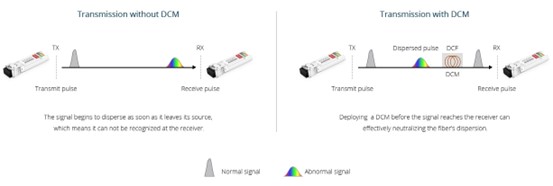
- Dispersion-Compensating Fiber (DCF): Dispersion-compensating fiber (DCF) is a specialized type of optical fiber used to counteract the dispersion effects of standard transmission fibers. Its dispersion properties are designed to be the exact opposite of the transmission fiber, effectively neutralizing the distortion caused by chromatic dispersion. Typically used for spans of 80–100 kilometers, DCF provides a reliable and straightforward solution for fixed dispersion compensation in long-haul and metro optical networks. Its ease of integration and cost-effectiveness make it a common choice in many systems.
- Chirped Fiber Bragg Gratings (CFBG): Chirped Fiber Bragg Gratings (CFBG) are compact optical devices that manage dispersion by reflecting light at specific wavelengths with controlled time delays. This process corrects signal distortion caused by dispersion. The design of CFBGs allows for tunability, achieved through thermal or mechanical adjustments, enabling dynamic compensation based on network conditions. These devices are widely used in systems requiring both precise and adaptable dispersion control.
- Virtually Imaged Phased Arrays (VIPA): VIPA- are optical components developed to manipulate light in Dense Wavelength Division Multiplexing (DWDM) systems. They can compensate dispersion across multiple wavelengths simultaneously, but their primary role is as high-resolution spectral dispersers rather than direct dispersion compensators. While Dispersion Compensating Fibers (DCF) and Chirped Fiber Bragg Gratings (CFBG) dominate practical dispersion management in commercial DWDM systems, VIPAs find stronger use in optical signal processing, optical spectrum analyzer (OSA) design, and DWDM channel analysis, where fine spectral resolution and precise control are required. They are essential for high-capacity, multi-channel optical networks. VIPAs handle wavelength-dependent dispersion and ensure consistent performance in complex telecommunication systems.
- Amplifiers (Optional): Some dispersion compensation modules include erbium-doped fiber amplifiers (EDFAs) to counteract signal loss introduced by the dispersion compensating process. These amplifiers restore signal strength and ensure the optical link maintains consistent power over long distances. Although not always standard components, they are essential in systems that require both dispersion correction and signal quality preservation.
- Optical Filters: Optical filters play a key role in enhancing signal quality by eliminating unwanted spectral components. They help maintain a high signal-to-noise ratio (SNR) and prevent interference from noise and other distortions. By isolating the desired wavelengths, these filters ensure that only the correct signals are transmitted. This contributes to the overall reliability and performance of the optical system.
- Tunable Dispersion Modules: Tunable dispersion modules provide flexibility in adjusting the amount of compensation to match real-time system demands. These modules often use technologies like temperature-controlled fiber gratings or electronically adjustable components to fine-tune dispersion levels. Their ability to adapt to dynamic network requirements makes them indispensable for modern optical systems with variable operational conditions.
- Mechanical and Thermal Control Systems: Control systems for mechanical and thermal adjustments are essential in ensuring the stability of dispersion compensating components, especially in tunable modules. They maintain optimal performance by compensating for environmental variations such as temperature changes. These systems ensure that the dispersion compensation remains precise and effective, even under fluctuating conditions.
- Connectors and Packaging: High-quality optical connectors and robust packaging are integral to the performance of DCMs. Connectors minimize insertion loss and provide efficient coupling with transmission fibers, while durable packaging protects the module’s internal components from environmental and mechanical stress. Compact designs also ensure that the modules can be easily integrated into various optical systems without requiring significant space.
- Monitoring and Control Interfaces: Modern DCMs often feature monitoring and control interfaces to provide real-time performance data. These interfaces allow for the tracking of dispersion levels, signal loss, and overall system integrity. Integration with network management systems enables operators to make necessary adjustments quickly and ensures optimal performance throughout the life of the system.
Importance of Dispersion Compensation
Chromatic dispersion poses a significant challenge in optical fiber communication, particularly in high-speed and long-distance transmissions. It occurs due to the variation in the propagation speed of different wavelengths of light within the fiber, leading to pulse broadening and signal degradation. Without proper compensation, chromatic dispersion can severely impact data integrity and system performance.
Effects of Chromatic Dispersion
- Inter-symbol Interference (ISI): In optical communication, digital signals are transmitted as a sequence of optical pulses. Chromatic dispersion causes these pulses to spread over time and overlap with consecutive pulses. This overlap results in inter-symbol interference (ISI), where the receiver struggles to distinguish individual bits. The increased bit overlap raises bit error rates (BER) and reduces data accuracy.
- Signal Distortion: As pulses broaden and merge, the signal-to-noise ratio (SNR) deteriorates and makes data recovery more difficult. This distortion reduces the clarity and fidelity of the transmitted signal. The compromised signal quality affects overall system performance, especially in dense wavelength-division multiplexing (DWDM) systems and high-speed networks.
Role of Dispersion Compensation Modules (DCMs)
To counteract these effects, dispersion compensation modules (DCMs) are deployed in optical networks. These specialized components introduce an equal but opposite amount of dispersion, effectively negating the unwanted broadening and restoring signal integrity. The benefits of DCMs include:
- Enhanced Signal Integrity: By preserving the original pulse shape, DCMs reduce ISI and distortion. This allows the receiver to accurately interpret transmitted data, improves transmission clarity, lowers error rates, and enhances overall network reliability.
- Support for High Data Rates: In modern optical networks, data rates have increased significantly, reaching 40 Gbps, 100 Gbps, and beyond. At these speeds, even minor dispersion effects can cause severe performance degradation. DCMs counteract these issues and ensure the efficient operation of high-speed optical communication systems without excessive error correction overhead.
- Facilitating Scalability and Long-Distance Transmission: As network demands grow, operators must extend fiber link distances and support more complex topologies. DCMs extend the reach of optical signals over hundreds of kilometers and improve the scalability of long-haul and metro networks. They also enable flexible deployment in DWDM systems and provide dispersion compensation across multiple channels without affecting wavelength integrity.
Key Performance Parameters
The performance of DCMs is defined by several critical parameters:
- Dispersion Amount and Slope: The dispersion amount and slope determine how effectively a DCM compensates for chromatic dispersion, measured in ps/nm for first-order dispersion and ps² for higher-order dispersion. These parameters are crucial for wideband applications and DWDM systems, where multiple wavelengths require precise compensation to prevent pulse broadening and inter-symbol interference (ISI). Advanced DCMs address both first-order and higher-order dispersion effects to maintain signal integrity over long distances.
- Insertion Loss: Insertion loss refers to the optical power reduction as light passes through the DCM, measured in decibels (dB). Higher insertion loss weakens signals and increases the need for optical amplification, which in turn raises noise accumulation and power consumption. FBG-based DCMs offer lower insertion loss compared to DCF-based DCMs and provide greater efficiency by reducing signal degradation while ensuring a high signal-to-noise ratio (SNR).
- Tunable Dispersion: Tunable dispersion allows real-time adjustment of dispersion compensation and proves essential for dynamic and reconfigurable optical networks. This feature enables adaptive compensation for different transmission distances, modulation formats, and routing changes. Liquid crystal-based tunable filters, FBG-based systems, and electronically controlled dispersion compensators offer this flexibility and maintain optimal network performance.
- Compactness and Nonlinearity: Compactness and nonlinearity are important for modern network scalability. Compact DCMs, based on integrated photonic circuits (IPCs) and planar lightwave circuits (PLCs), save space while maintaining efficiency. However, nonlinear effects such as self-phase modulation (SPM), cross-phase modulation (XPM), and four-wave mixing (FWM) can degrade signal quality, especially in high-power transmissions. FBG-based and DSP-driven DCMs mitigate these nonlinear impairments while providing precise dispersion correction.
- Polarization Mode Dispersion (PMD): Polarization mode dispersion (PMD) arises from birefringence in optical fibers and causes polarization-dependent delays and signal distortion. This effect becomes critical in 100 Gbps and beyond networks, where minor polarization shifts can lead to severe performance degradation. PMD effects fluctuate due to temperature variations, mechanical stress, and fiber imperfections. PMD compensation modules (PMDCs) correct polarization variations through techniques such as polarization diversity receivers, adaptive PMD equalization, and machine-learning-based PMD correction.
Applications of Dispersion Compensation Modules
Dispersion Compensation Modules (DCMs) are widely used in optical communication systems to manage chromatic dispersion and maintain signal integrity over long distances. In long-haul optical networks extending beyond 100 km, DCMs are critical for preserving pulse shape and minimizing signal distortion, making them indispensable in intercontinental links and submarine cable systems. They are also a key component in Dense Wavelength Division Multiplexing (DWDM) networks, where multiple wavelengths are transmitted simultaneously through a single fiber. By correcting wavelength-dependent dispersion, DCMs enable high capacity, high-speed data transmission with reduced bit error rates. In metro networks covering urban and suburban areas, DCMs help sustain reliable performance by compensating for dispersion variations arising from different fiber types, link lengths, and network configurations.
Beyond communication networks, DCMs play an important role in advanced photonic and sensing applications. In mode-locked laser systems, which generate ultrashort optical pulses, dispersion control is essential for stable pulse formation and timing accuracy. DCMs help manage these dispersion effects, supporting applications such as biomedical imaging, ultrafast spectroscopy, and precision metrology. Additionally, fiber-optic sensor systems used for industrial, environmental, and structural health monitoring rely on DCMs to ensure accurate signal transmission over long distances. By maintaining signal fidelity, DCMs enable precise data acquisition and reliable analysis in demanding sensing environments.
Gophotonics has listed Dispersion Compensation Modules from the leading companies. Use the parametric search tool to find products based on your requirements.

