10 Single-Photon Sources
from
6 Manufacturers
10 Products
from
6 Manufacturers
Page 1 of 1
What is a Single-photon Source?
A Single-photon Source (SPS) is a specialized optical device designed to release exactly one photon at a time, either on demand or with high probability. Unlike conventional light sources that emit many photons simultaneously, an SPS generates individual photons in a well-defined spatial, spectral, and temporal mode, closely approximating a true single-photon (1-photon Fock) quantum state. In propagating beams such as free space or optical fibers, the photon is represented by a localized wave packet with a specific temporal and spectral profile, allowing multiple single photons to travel sequentially without overlapping. These sources are foundational to quantum technologies, where precise photon generation is essential for secure communication, quantum computing, and advanced metrology.
Working principle of Single Photon Sources
Single-photon sources work by using a specially designed quantum emitter that can release only one photon at a time. First, the emitter is excited to a higher energy state using optical or electrical stimulation. Once excited, it naturally relaxes back to its ground state, and during this process, it emits exactly one photon. This photon is then collected using optical components such as lenses or waveguides and directed to the required system or experiment. In on-demand single-photon sources, the timing of this emission is precisely controlled, allowing photons to be generated exactly when needed for applications in quantum communication, sensing, and computing.
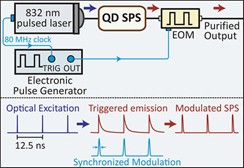
Fig: Single-photon source made from a quantum dot
The schematic shows a single-photon source made from a quantum dot that is excited using a pulsed laser. Each laser pulse makes the quantum dot emit a photon. Before these photons are sent out, they pass through an electro-optic modulator that acts like a fast shutter. It opens only for the short moment when all parts of the photon pulse are perfectly aligned in phase. By doing this, the modulator removes any extra or unwanted light from the quantum dot, resulting in a cleaner output with more true single photons. This process also ensures that the photons are identical, making them highly suitable for quantum applications.
Types of Single Photon Sources
- Isolated Quantum Emitters (Deterministic Sources): A single quantum emitter such as a quantum dot, atom, ion, or molecule is excited using optical or electrical pumping. The emitter can hold only one excitation at a time, so it releases exactly one photon when it returns to the ground state. By repeating the excitation cycle, the system generates single photons one at a time in a controlled manner.
- Heralded Single-Photon Sources (Probabilistic Pair Sources): A pump laser interacts with a nonlinear medium to produce photon pairs through SPDC or SFWM processes. Detection of one photon in the pair, known as the herald, confirms the presence of its partner. The heralded photon is then used as the single-photon output, although the generation time remains random.
- Multiplexed Single-Photon Sources: Several probabilistic photon-pair sources or time-bin channels operate in parallel. When any channel successfully produces a heralded photon, optical switches or delay networks route that photon to the output. This arrangement increases the chance of delivering a single photon when required.
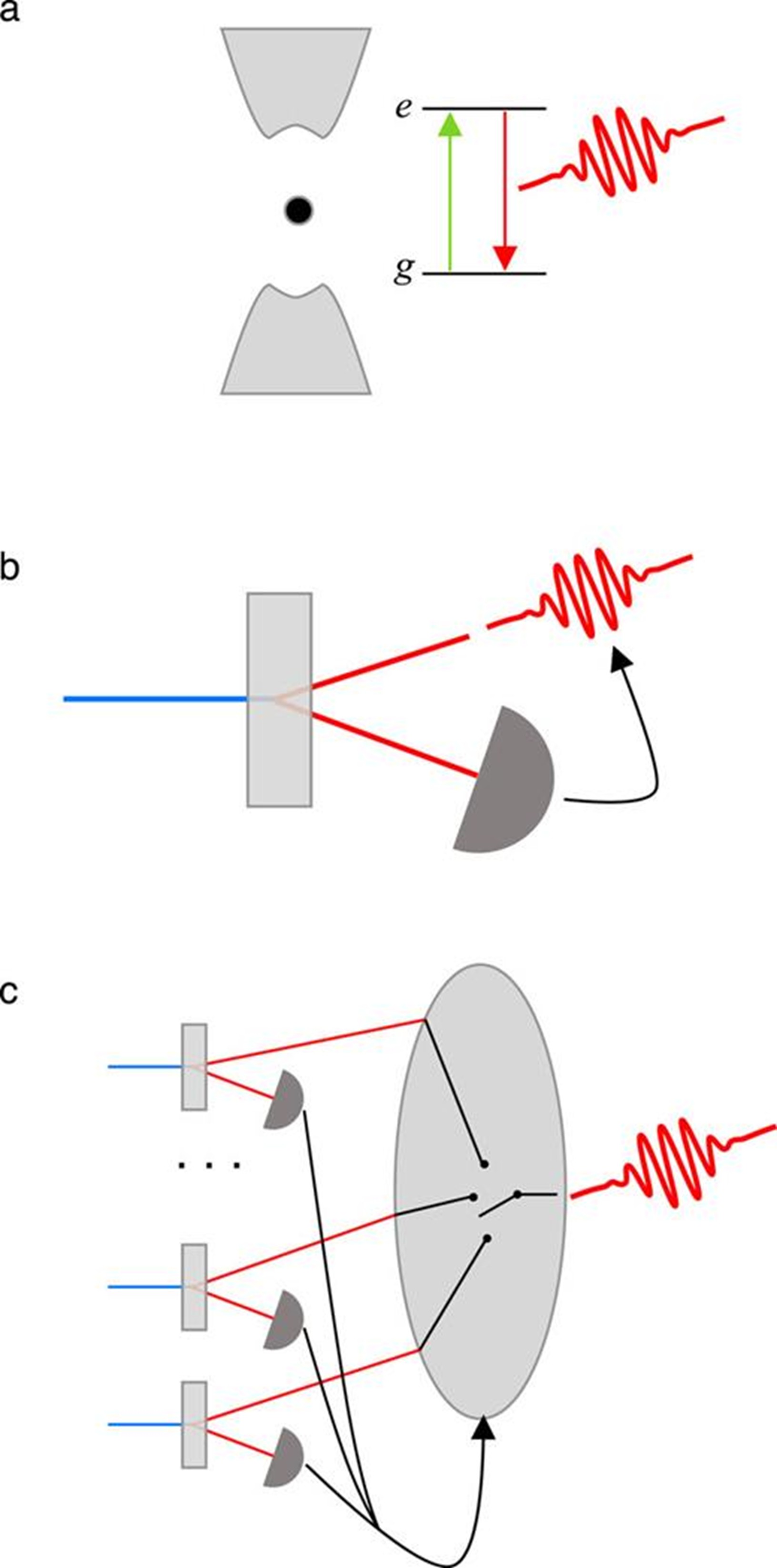
Fig: Types of single-photon sources: (a) isolated quantum systems (e.g., a single particle in an optical cavity with ground g and excited e states), (b) heralded single-photon sources from photon pairs, and (c) multiplexed source (as one example, spatial multiplexing is shown).
Applications of Single-Photon Sources
Single-photon sources play a central role in fundamental quantum optics research, enabling experiments that probe the very foundations of quantum mechanics. They allow scientists to perform tests of photon statistics, wave–particle duality, delayed-choice experiments, Bell inequality violations, and even quantum teleportation. These controlled single-photon emissions make it possible to explore quantum coherence and entanglement with exceptional precision.
In quantum communication, single-photon sources support secure information transfer through Quantum Key Distribution (QKD), such as the Bennett–Brassard (BB84) protocol, where individual photons act as information carriers that cannot be intercepted without detection. They are also used in quantum random number generators, which produce truly unpredictable randomness based on single-photon detection events. These capabilities form the backbone of emerging quantum-secure communication networks.
Single-photon sources also enable key advancements in quantum computing, metrology, and sensing. In photonic quantum computing, they generate indistinguishable photons that function as “flying qubits” for logic operations, interference experiments, and multiphoton boson sampling. In quantum metrology, they serve as radiometric standards and support enhanced precision measurements, allowing accurate calibration of single-photon detectors and enabling quantum-enhanced sensing techniques for high-sensitivity applications.
GoPhotonics lists Single-Photon Sources from leading manufacturers. Use the parametric search tool to filter products based on type, photon-pair generation rate, single-photon purity, wavelength, and polarization.

