28 Infrared Emitters
from
5 Manufacturers
28 Products
from
5 Manufacturers
Page 1 of 2
What are Infrared Emitters?
Infrared emitters are devices that generate light in the infrared (IR) region of the electromagnetic spectrum, typically covering wavelengths from approximately 700 nm to several micrometers. They operate by converting electrical energy into infrared radiation, either through thermal emission from a heated material or through direct photon generation in a semiconductor junction. Although the term infrared emitter could broadly apply to any IR-emitting source, it is most commonly used to describe non-laser infrared light sources, particularly thermal infrared emitters and infrared light-emitting diodes (IR LEDs).
Compared to lasers, infrared emitters produce incoherent radiation with relatively wide spectral bandwidth and beam divergence. This makes them easier to integrate, safer to operate, and well suited for applications that require stable, broadband, or modulated infrared output rather than tightly focused or coherent beams. As a result, infrared emitters are widely used across sensing, spectroscopy, industrial processing, calibration, and consumer electronics.
Working Principle of Infrared Emitters
Infrared emitters operate on the fundamental principle of electrical-to-radiative energy conversion. Depending on the technology, electrical input energy is either transformed into heat that produces infrared radiation or directly converted into infrared photons through electronic transitions within a semiconductor material.
In thermal-based devices, infrared radiation is generated as a consequence of heating, while in semiconductor-based devices, photon emission occurs through electron–hole recombination. The chosen emission mechanism directly influences the emitter’s wavelength range, spectral width, modulation speed, efficiency, and application suitability.
Key Components of an Infrared Emitter System
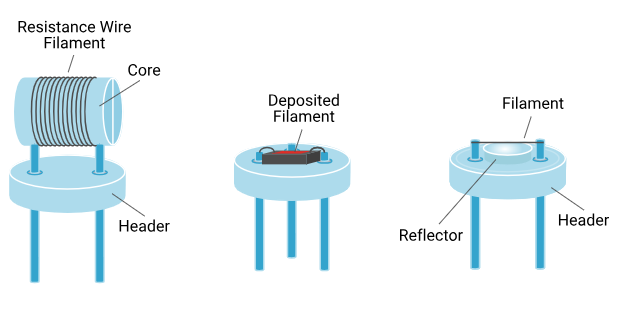
Emitting Element: The emitting element is the core component responsible for generating infrared radiation. In thermal emitters, this may be a heated filament, ceramic tube, or thin foil. In IR LEDs, it is a semiconductor structure that emits infrared light when electrically driven.
Reflector and Optical Filtering: Some infrared emitters incorporate reflectors, such as gold-plated reflectors, to direct radiation forward for improved efficiency. Infrared filters may also be used to restrict emission to a specific spectral region.
Electrical Control and Housing: Infrared emitters are designed for stable electrical operation. Certain thermal emitters feature minimal resistance drift and a low temperature coefficient of resistance, simplifying control. Advanced packaging with optical windows allows reliable operation across a wide temperature range.
Connector and Cabling (for IR Transmission): In remote control and signal repeating applications, IR emitters typically include a wired connection, often using a 3.5 mm mono jack and a thin cable, to transmit signals from a source to the emitter head.
Types of Infrared Emitters
Thermal Infrared Emitters: Thermal infrared emitters generate radiation by electrically heating a material until it reaches a temperature at which it emits infrared radiation in accordance with blackbody radiation principles. Their emission is broadband, with intensity and peak wavelength primarily determined by temperature rather than material band structure.
These emitters include compact incandescent-style sources used in spectroscopy and analytical instrumentation, such as Nernst lamps and globar sources, which are widely employed in FTIR spectrometers. Calibrated blackbody sources, often based on heated ceramic or metallic cavities operating at temperatures around 1000 °C, are used for detector calibration and radiometric testing.
For applications requiring modulation, pulsed thermal emitters utilize thin foils or membranes with low thermal capacitance, enabling infrared output to be modulated on millisecond timescales. High-power thermal infrared heaters are also used in industrial heating, fabrication, and printing applications.
Infrared LEDs: Infrared light-emitting diodes (IR LEDs) generate infrared radiation through electron–hole recombination in a semiconductor p–n junction. When forward biased, electrical current drives charge carriers to recombine, releasing energy in the form of infrared photons. The emission wavelength is precisely defined by the semiconductor bandgap.
IR LEDs are available at well-defined center wavelengths such as 850 nm, 880 nm, and 940 nm, with output powers ranging from a few milliwatts to several hundred milliwatts. High-power variants can reach multi-watt output levels. While their emission is less directional than laser diodes, IR LEDs offer fast modulation, high electrical efficiency, long operational lifetimes, and simplified laser safety considerations.
Applications of Infrared Emitters
Infrared emitters are widely used as broadband sources in spectroscopy, where consistent infrared output is sufficient for analytical measurements. In industrial environments, they serve as infrared heaters for fabrication processes and devices such as laser printers.
In infrared transmission systems, emitters enable line-of-sight signal delivery by transmitting modulated infrared light that remains distinguishable from ambient infrared sources. In consumer electronics, wired infrared emitters are commonly used to relay remote-control signals to concealed or remotely placed A/V equipment.
Click here to learn more about infrared emitters.
Gophotonics has listed Infrared Emitters from the leading companies. Use the parametric search tool to find products based on your requirements.

