What is an Optical Cryostat?
An optical cryostat is a vacuum-insulated system designed to cool samples to cryogenic temperatures while providing clear optical access, enabling light to enter and exit the chamber for highly sensitive optical experiments. Unlike standard cryostats, optical cryostats incorporate precision optical windows and low-vibration cooling mechanisms that allow researchers to illuminate a sample, collect emitted or transmitted light, and perform spectroscopy or imaging at temperatures ranging from a few Kelvin down to the sub-Kelvin regime. They are essential for studying materials whose optical or electronic properties change significantly at low temperatures, including quantum materials, semiconductors, and astrophysical detector components.
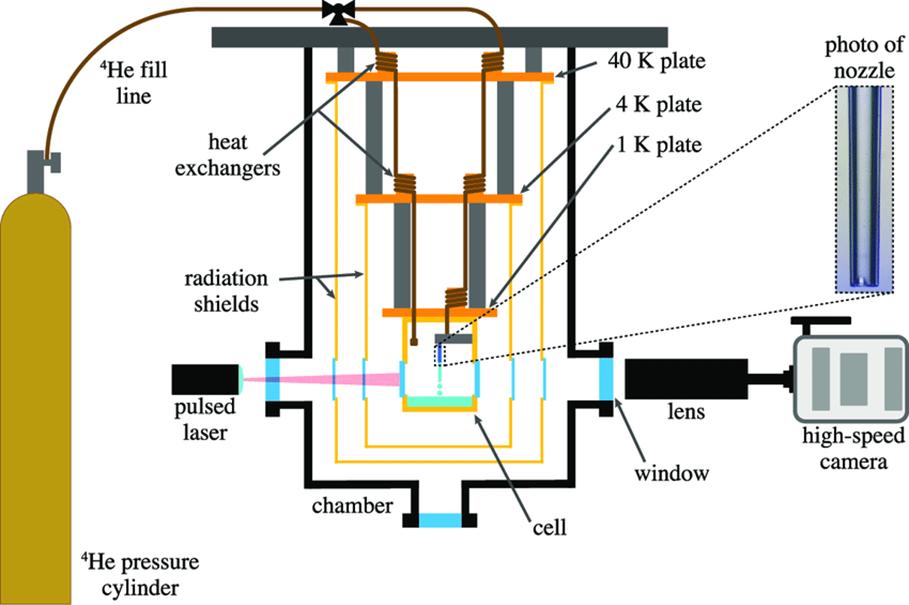
Fig: Experimental-Setup of Optical Cryostat
Optical cryostats use either liquid cryogens such as liquid helium or nitrogen, or cryogen-free mechanical coolers, supported by a vacuum jacket and radiation shields that minimize heat transfer. By combining cooling power with integrated heater control, users can achieve precise and stable temperature regulation. Optical windows made from materials such as sapphire, quartz, or ZnSe allow experiments across UV, visible, and infrared wavelengths.
Working of an Optical Cryostat?
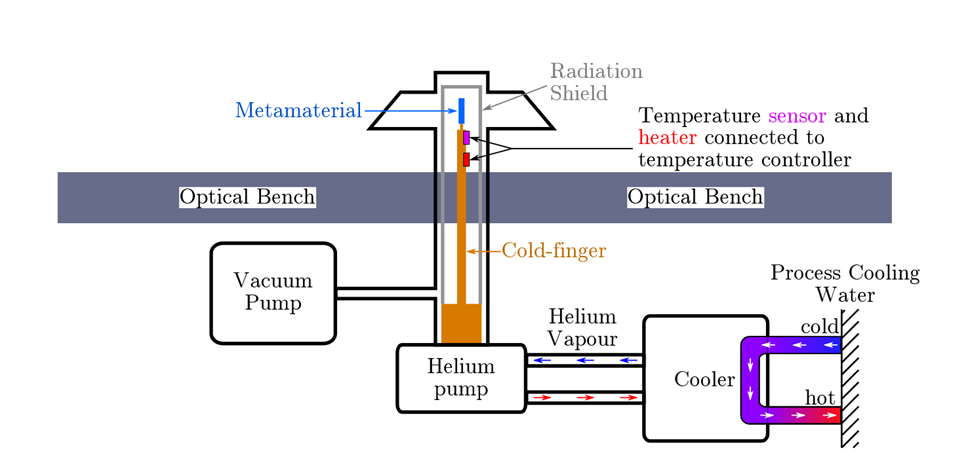
Fig: Working of an Optical Cryostat
An optical cryostat operates by cooling a sample to cryogenic temperatures inside a vacuum-insulated chamber while providing optical access through windows. A cryocooler or liquid cryogen supplies the cooling power, lowering the temperature of a cold finger that directly cools the sample. The vacuum jacket minimizes convective heat transfer, and a radiation shield surrounding the cold region reduces black-body heating from the environment. Temperature sensors and a controlled heater regulate the sample temperature with high precision, allowing stable operation from a few Kelvin to higher controlled temperatures.
In many systems, helium vapour or a closed-cycle cooler transfers heat away from the cold finger, while a vacuum pump maintains the low-pressure environment required for thermal isolation. Light enters and exits the cryostat through optical windows, enabling spectroscopy or microscopy at cryogenic temperatures. The sample, mounted on the cold finger, cools rapidly as heat is extracted, while the temperature controller adjusts heating dynamically based on sensor feedback. Together, the vacuum shroud, cryocooler, cold finger, radiation shield, and optical windows form a stable, low-noise environment essential for characterizing superconducting metamaterials, quantum devices, semiconductors, and other temperature-sensitive optical samples.
Key Components
The key components of an optical cryostat work together to create a controlled cryogenic environment that enables precise optical measurements over a wide temperature range.
Cryocooler (Closed-Cycle Cooler): The cryocooler is a mechanical refrigeration system used to cool the sample without the need for liquid helium. Modern closed-cycle designs, particularly pulse-tube cryocoolers, provide low vibration operation and support a wide temperature range from a few Kelvin up to several hundred Kelvin. This combination makes them especially suitable for optical spectroscopy experiments that demand stable and repeatable temperature control.
Vacuum Shroud: The vacuum shroud is typically a stainless steel or aluminum enclosure that creates and maintains the required vacuum environment around the sample. It houses the sample space, protects sensitive components from contamination, and commonly includes multiple optical window ports to allow laser or probe beams to access the sample along defined beam paths.
Radiation Shield: The radiation shield is generally fabricated from nickel-plated OFHC copper to lower emissivity and enhance thermal stability. Its primary function is to reduce radiative heat transfer to the sample, thereby improving temperature stability. In some designs, the shield also incorporates cold windows to further reduce the thermal load entering the sample region.
Sample Holder: The sample holder is a thermally conductive mount designed to securely hold the sample during measurements. It is available in various configurations to accommodate thin films, bulk samples, liquid samples, or devices that require electrical connections. OFHC copper is commonly used to ensure efficient heat flow between the cryocooler and the sample.
Optical Windows: Optical windows provide controlled optical access to the sample while maintaining the cryostat vacuum. These windows are selected based on the wavelength range of the experiment and may be made from materials such as sapphire, quartz, ZnSe, KBr, or CsI. Depending on the application, the windows can be anti-reflection coated, wedged to suppress interference fringes, or designed at Brewster angles to minimize reflection losses.
Sample Mounting System: The sample mounting system ensures efficient thermal contact between the sample and the sample holder, which is critical for accurate temperature control. Materials such as indium foil or silver layers are often used to improve thermal conduction. Proper mounting reduces thermal gradients and ensures that the measured temperature accurately reflects the sample condition.
Types of Optical Cryostats
- Liquid Helium Flow Cryostats: Liquid helium flow cryostats use a continuous stream of LHe to reach extremely low temperatures, often approaching 2 K, making them suitable for experiments requiring minimal thermal noise. They provide excellent temperature stability and fast cooldown but require a consistent helium supply and careful handling due to helium scarcity and cost.
- Liquid Nitrogen Flow Cryostats: Liquid nitrogen flow cryostats operate around 77 K, offering an economical solution for mid-cryogenic temperature experiments. They are easy to use, widely available, and ideal for optical studies that do not require sub-Kelvin operation.
- Bath Cryostats: Bath cryostats cool samples by immersing them in a larger reservoir of liquid helium or nitrogen, providing long, uninterrupted cooling periods. Their simple design makes them robust and reliable, but they require periodic refilling and may have limited optical access depending on the geometry.
- Closed-Cycle Cryostats (Mechanical Cryocoolers): Closed-cycle cryostats use mechanical refrigerators, such as pulse-tube or Gifford–McMahon coolers, to achieve cryogenic temperatures without the need for liquid cryogens. They offer low operational cost and high convenience, making them ideal for continuous optical experiments and long-term measurement setups.
- Vibration-Isolated Closed-Cycle Cryostats: Some closed-cycle systems incorporate vibration isolation stages to minimize mechanical noise transmitted from the cryocooler to the sample space. These are preferred for ultrahigh-precision optical experiments, such as interferometry or spectroscopy on fragile quantum materials where even nanometer-scale vibrations can disrupt measurements.
Applications of Optical Cryostats
Optical cryostats are widely used in spectroscopy, microscopy, and material characterization where low temperatures are required to reduce thermal noise and reveal fine spectral features. Techniques such as photoluminescence, fluorescence spectroscopy, micro-Raman, FTIR, ultrafast spectroscopy, and THz spectroscopy rely on cryostats to stabilize samples at cryogenic temperatures and enhance measurement sensitivity.
In materials science, optical cryostats enable the study of superconductors, quantum materials, 2D materials, and metamaterials under controlled thermal conditions. Researchers use them to explore phase transitions, carrier dynamics, and low-energy excitations that are only observable at low temperatures.
Optical cryostats also support applications in quantum optics, quantum computing, and astrophysics. They provide stable cold environments for single-photon detectors, superconducting circuits, quantum light sources, and space-grade optical detectors. Specialized optical cryostats are used in cryogenic microscopes and in the instrumentation of space observatories where ultra-low-noise measurements are essential.
Gophotonics has listed Terahertz Detectors from the leading companies. Use the parametric search tool to find products based on your requirements.

