93 Acousto-Optic Tunable Filters
from
10 Manufacturers
93 Products
from
10 Manufacturers
Page 1 of 9
What is an Acousto-Optic Tunable Filter (AOTF)?
An Acousto-Optic Tunable Filter (AOTF) is a device used for precise optical filtering by utilizing the interaction between light and sound waves within a birefringent crystal. This interaction, known as the acousto-optic effect, occurs when high-frequency sound waves induce periodic changes in the refractive index of the crystal. As sound waves travel through the crystal, they create a dynamic diffraction grating, which selectively diffracts light of certain wavelengths. The ability to control the RF signal applied to the crystal allows the filter to tune wavelengths electronically, which provides a highly efficient, fast, and reliable means of spectral control without requiring mechanical adjustments.
Working Principle of Acousto-Optic Tunable Filter
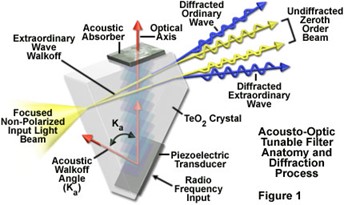
The Acousto-Optic Tunable Filter (AOTF) functions by modulating the refractive index of a birefringent crystal using acoustic waves. This enables precise wavelength selection and intensity control, which makes AOTFs highly efficient for spectral filtering applications.
A key aspect of its operation is diffraction and phase matching. When an RF signal is applied, acoustic waves propagate through the crystal and induce periodic variations in the refractive index. If the wavelength of the incident light satisfies a specific phase-matching condition, diffraction occurs and enables selective filtering. As a result, certain wavelengths are transmitted while others are blocked based on the interaction between light and the acoustic wave.
The wavelength selection in an AOTF is governed by multiple factors, such as the RF frequency, the velocity of acoustic waves, and the birefringence of the crystal. By varying the RF frequency, the filter achieves dynamic tuning to different wavelengths without requiring mechanical adjustments. This allows fast and precise spectral control.
In addition to wavelength tuning, the AOTF also provides intensity control. The diffraction efficiency of an acousto-optic device increases with the RF power applied to the crystal, since the acoustic wave amplitude is proportional to the drive power. At low to moderate RF powers, efficiency rises approximately linearly, but as the device approaches its design limit, efficiency saturates near its theoretical maximum. Beyond this point, further increases in RF power do not improve performance and may even degrade it due to thermal loading, acoustic absorption, and other nonlinear effects. Adjusting the RF power modulates the intensity of the diffracted light and enables simultaneous control over both wavelength and optical power.
Key Components of Acousto-Optic Tunable Filter
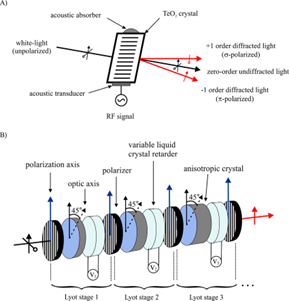
An Acousto-Optic Tunable Filter (AOTF) consists of several key components that enable precise wavelength selection and intensity control. These include a birefringent crystal for diffraction, a piezoelectric transducer that generates acoustic waves, and an RF driver that controls frequency. Additional elements such as polarizers, acoustic absorbers, and optical housing enhance efficiency and stability, which ensures reliable performance in spectral filtering applications.
- Birefringent Crystal: The core component of an AOTF is the birefringent crystal, which serves as the medium for acousto-optic interaction. Common materials include tellurium dioxide (TeO₂) and quartz, selected for their high acousto-optic figure of merit and optical transparency across a broad wavelength range. These materials enable precise wavelength selection by exploiting their birefringence, where light traveling through the crystal experiences different refractive indices depending on its polarization state. When an acoustic wave is introduced, it creates periodic variations in the refractive index, leading to diffraction of specific light wavelengths. The choice of crystal material affects key performance factors such as diffraction efficiency, optical bandwidth, and wavelength range.
- Piezoelectric Transducer: The piezoelectric transducer converts radio frequency (RF) signals into acoustic waves that propagate through the birefringent crystal. It is typically made from materials like lithium niobate (LiNbO₃) or lead zirconate titanate (PZT) due to their high electromechanical coupling efficiency. When an RF voltage is applied, the transducer undergoes mechanical deformation and generates ultrasonic waves that travel through the crystal. These acoustic waves create periodic refractive index variations and diffract specific wavelengths. The placement and efficiency of the transducer affect the spectral resolution and tuning speed of the AOTF.
- RF Driver:The RF driver generates and controls the RF signals applied to the piezoelectric transducer. It determines the frequency and power of the acoustic waves, directly influencing the wavelength tuning range and diffraction efficiency of the AOTF. The RF driver typically consists of:
- Frequency synthesizers to provide precise frequency control.
- Power amplifiers to regulate the signal strength.
- Modulation circuits to enable dynamic adjustments based on real-time requirements. Higher RF frequencies correspond to shorter diffraction wavelengths, while adjustments to RF power modulate the intensity of the diffracted light. The stability and resolution of the RF driver are critical for ensuring accurate and repeatable spectral filtering.
- Polarizers: In collinear acousto-optic tunable filter (AOTF) designs, polarizers play a crucial role in enhancing spectral contrast by suppressing unwanted polarization components. While polarizers are beneficial in both collinear and non-collinear configurations, they are particularly critical in collinear designs, where the interaction geometry makes polarization filtering essential for achieving high contrast and clean spectral selection. Since birefringent crystals support multiple polarization modes, polarizers ensure that only the correctly diffracted wavelengths are transmitted. These are typically placed at the input and output of the AOTF to enhance spectral purity by blocking unwanted polarization states. The choice of polarizer material and alignment significantly affects transmission efficiency and contrast ratio.
- Acoustic Absorbers: Acoustic absorbers are installed within the AOTF system to prevent unwanted reflections of acoustic waves inside the birefringent crystal. If these reflections are not minimized, they can cause secondary diffraction effects, leading to spectral artifacts and reduced filter performance. Acoustic absorbers are typically made from materials with high acoustic damping properties, such as rubber-based compounds or porous ceramics, which dissipate excess acoustic energy and enhance diffraction efficiency.
- Optical Housing and Alignment Systems: The optical housing and alignment system ensures precise positioning of all optical and electronic components.
Advanced AOTF systems may include thermal stabilization mechanisms to counteract temperature-induced variations in birefringence. These mechanisms help maintain consistent performance across different operational conditions.
Filter Designs of Acousto-Optic Tunable Filter
Acousto-Optic Tunable Filters (AOTFs) are designed in different configurations based on application requirements, with the three main types being collinear, non-collinear, and waveguide-based designs. Each design influences key performance aspects such as diffraction efficiency, angular acceptance, and integration capabilities.
Collinear Filters
A collinear filter is a type of Acousto-Optic Tunable Filter (AOTF) in which both the optical and acoustic waves propagate along the same axis within the birefringent crystal. This configuration maximizes the interaction length, leading to high diffraction efficiency and precise wavelength selection. However, its narrow angular acceptance requires careful alignment of the incident light. To ensure that only the desired wavelength is transmitted, polarizers are commonly used to isolate the diffracted light. Collinear filters are widely used in applications demanding high spectral resolution, such as hyperspectral imaging and laser spectroscopy.
Non-Collinear Filters
A non-collinear filter is designed so that the optical and acoustic waves interact at an angle rather than travel along the same axis. This configuration broadens the angular acceptance, which allows greater adaptability to various optical setups. However, the shorter interaction length reduces diffraction efficiency compared to collinear designs. Despite this, non-collinear filters provide better wavelength separation and suit applications that need rapid spectral tuning, such as multispectral imaging and optical communication systems.
Waveguide-Based Filters
A waveguide-based filter is an AOTF designed for integration into photonic circuits, replacing bulk crystals with compact optical waveguides. This structure confines both light and acoustic waves within a small area, enabling fast wavelength tuning with low power consumption. The miniaturized design makes waveguide-based filters ideal for telecommunications and lab-on-chip optical systems, where efficient and high-speed spectral filtering is essential for advanced signal processing.
Applications of Acousto-Optic Tunable Filter
- Multispectral Imaging: AOTFs are widely used in multispectral imaging, such as in fluorescence microscopy, remote sensing, and agricultural monitoring. They enable rapid wavelength tuning, allowing for detailed and high-speed spectral scanning, which is essential for gathering multispectral data across different wavelengths.
- Laser Spectroscopy: In laser spectroscopy, AOTFs are used to filter specific wavelengths of light for excitation or emission spectra. This is crucial for techniques like fluorescence and Raman spectroscopy, where precise control over the wavelength is needed for accurate measurements and analysis.
- Optical Communication: Acousto-optic tunable filters (AOTFs) can enhance optical communication systems by enabling wavelength division multiplexing (WDM) in fiber-optic networks. However, they are not widely deployed in large-scale telecom WDM infrastructure, since their insertion loss and limited channel selectivity make them less practical compared to solutions such as thin-film filters and arrayed waveguide gratings (AWGs). Instead, AOTFs are more commonly used in niche applications requiring dynamic wavelength tuning, optical signal analysis, or reconfigurable filtering.
- Biomedical Imaging: AOTFs are employed in advanced biomedical imaging techniques like confocal and two-photon microscopy. They offer precise control over the light used to excite fluorophores, facilitating high-speed imaging with minimal distortion. This is valuable for cellular imaging, tissue analysis, and real-time diagnostics.
- Wavelength-Tunable Light Sources: AOTFs can be integrated into light sources, allowing for dynamically tunable output wavelengths. This feature is beneficial for research and diagnostics, as it allows for flexible and precise wavelength control in various experiments and analyses.
- Polarimetry and Remote Sensing: In polarimetry and remote sensing, AOTFs help filter and analyze polarized light. This is particularly useful for environmental monitoring, atmospheric studies, and astronomical observations, where specific light wavelengths and polarizations need to be studied in detail.
Gophotonics has listed Acousto-Optic Tunable Filters from the leading companies. Use the parametric search tool to find products based on your requirements.

