109 Acousto-Optic Q-Switches
from
10 Manufacturers
109 Products
from
10 Manufacturers
Page 1 of 10
What are Acousto-optic Q-switches (AOQS)?
Acousto-optic Q-switches (AOQS) are devices used to control the laser cavity’s quality factor (Q-factor) to produce high-intensity, short-duration laser pulses. The operation relies on an acoustic wave generated by applying an RF signal to an acousto-optic modulator (AOM). This wave diffracts the laser light in the resonator, suppressing lasing. Once the RF signal is turned off, the accumulated energy in the resonator is rapidly released as a pulse of laser light. These switches are integral to solid-state lasers, where precise control of laser output is needed across a wide range of applications.
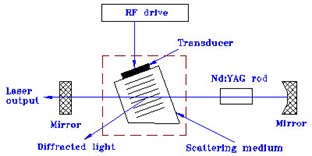
Key Components of Acousto-Optic Q-Switches
- Acousto-Optic Modulator (AOM): The AOM is the central element that generates the diffraction grating, which modulates the laser light circulating in the resonator. The RF signal applied to the AOM creates an acoustic wave that periodically changes the refractive index of the material, resulting in diffraction of the light.
- Transducer: The transducer converts the RF electrical signal into an acoustic wave. It is attached to the acousto-optic material and generates ultrasonic waves that interact with the laser light, creating the diffraction pattern.
- Laser Resonator: The optical cavity where the laser light circulates. The Q-switch is placed inside the resonator to modulate the light, effectively controlling the output of the laser.
- RF Driver: The RF driver provides the power needed for the AOM to generate the acoustic waves. It operates at a fixed frequency and controls the timing of the RF signal, which switches the Q-switch on and off.
Working Principle of Acousto-Optic Q-Switches
In an acousto-optic Q-switch, an RF signal is applied to the AOM, creating an acoustic wave that modulates the refractive index of the acousto-optic material. This wave forms a moving diffraction grating that diffracts the laser light circulating in the resonator, causing optical losses as the light exits the cavity. The laser is suppressed while the RF signal is applied.
Once the RF signal is switched off, the acoustic wave disappears, and the grating is no longer present. The resonator switches to a high-Q state, and the energy stored in the laser medium is released as a brief, intense pulse of light.
RF Drivers for Acousto-Optic Q-Switches
The RF driver provides the necessary power for the AOM and operates at a fixed modulation frequency. The required RF power often exceeds 10 W due to:
- High Laser Gain: High-gain lasers require significant loss modulation within the resonator, which increases RF power demand.
- Material Optimization: Materials with lower acousto-optic figures of merit may require more RF power to achieve low insertion losses.
- Large Apertures: High-power lasers necessitate larger AOM apertures, increasing the RF power needed for adequate diffraction.
Since RF power generates heat, cooling methods such as water cooling are often used to prevent overheating in high-power applications.
Applications of Acousto-Optic Q-Switches
Acousto-optic Q-switches are widely used in laser systems that require precise control over pulse timing, duration, and peak power. In laser marking applications, they enable high-precision engraving and marking on materials such as metals, plastics, and ceramics by generating short, high-energy pulses with excellent repeatability. Similarly, in material processing applications, such as laser cutting, welding, drilling, and micromachining, acousto-optic Q-switches provide stable and well-defined pulse characteristics.
In medical devices, they allow the generation of controlled, high-energy laser pulses required for procedures such as laser surgery, dermatology treatments, and ophthalmology. In scientific research, acousto-optic Q-switches are utilized to generate short, intense laser pulses for spectroscopy, precision measurements, and experimental studies that require high temporal resolution and reliable pulse performance.
Gophotonics has listed Acousto-Optic Q-Switches from the leading companies. Use the parametric search tool to find products based on your requirements.

