What are Pyroelectric Detectors?
Pyroelectric detectors are light sensors that operate based on the pyroelectric effect. They are extensively used to detect laser pulses, especially in the infrared spectral region, and can respond to a wide range of wavelengths. These thermal detectors use temperature fluctuations to create a charge change on the surface of pyroelectric crystals, which produces a corresponding electrical signal.
Pyroelectric detectors serve as the core components of many optical energy meters and typically function at room temperature, eliminating the need for cooling. Compared to energy meters using photodiodes, pyroelectric detectors offer a much broader spectral response. Additionally, pyroelectric sensors have various applications, including fire detection, satellite-based infrared detection, and motion detectors that identify individuals by their infrared emissions.
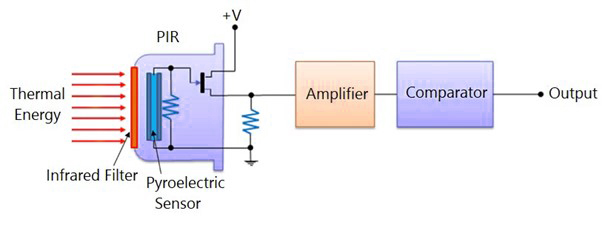
Key components
A typical pyroelectric detector consists of:
- Pyroelectric Material: Usually, a crystal such as lithium tantalate (LiTaO3) or lithium niobate (LiNbO3).
- Electrodes: These are placed on either side of the pyroelectric material to collect the generated charge.
- Infrared (IR) Absorber: A layer that absorbs IR radiation and converts it into heat, increasing the temperature of the pyroelectric material.
Working Principle
When infrared radiation hits the detector, it is absorbed by the IR absorber layer, causing a rise in the temperature of the pyroelectric material. The temperature change alters the polarization of the pyroelectric material. Since the material is not in thermal equilibrium, the dipole moments within the crystal structure change, leading to a change in the electric field.
This change in polarization results in a temporary voltage across the electrodes. The magnitude of this voltage is proportional to the rate of temperature change, not the absolute temperature. This means the detector responds to changes in infrared radiation rather than constant levels. The generated voltage is then measured and processed by an external circuit. This signal can be used to detect the presence and intensity of IR radiation.
Materials used
Only a small group of crystals possess sufficiently low crystal symmetry, such as monoclinic symmetry, to exhibit ferroelectric properties and the pyroelectric effect. These crystals have an electrical polarization that is dependent on temperature, leading to the generation of pyroelectric charges when the temperature changes.
Triglycine sulfate (TGS, (NH2CH2COOH)3·H2SO4) achieves particularly high sensitivity but has a low Curie temperature of 49°C. Above this temperature, its ferroelectric properties disappear. Deuterated triglycine sulfate (DTGS), a modified form of TGS, has a slightly higher Curie temperature of 61°C. However, both materials are unsuitable for applications where it is crucial to remain well below the Curie temperature. The pyroelectric response significantly increases just below the Curie temperature, affecting calibration, and there is a risk of deploying at higher temperatures. Additionally, TGS and DTGS are water-soluble, hygroscopic, and fragile, making them unsuitable for robust optical energy meters.
Other ferroelectric materials from the perovskite group include lead zirconate titanate (PZT, PbZrTiO3) and lead titanate (PT, PbTiO3). These materials are used in ceramic forms, such as deposited thin films because large crystals are difficult to produce. Additional dopants are needed for stability at room temperature. These materials can be manufactured at relatively low cost and are much more robust than TGS.
Parameters
Spectral Response: Like other thermal detectors, pyroelectric sensors can have a very broad spectral response due to their sufficiently broadband absorption. They can also be equipped with infrared filters to allow only light within a specific wavelength range.
Active Area: The active area of a pyroelectric detector is typically a circular disk or a rectangular area with a diameter ranging from a few millimeters to a few tens of millimeters. Detectors designed for higher pulse energies usually have larger active areas.
Surface Reflectivity: Ideally, a pyroelectric detector should absorb all incident light for maximum sensitivity. However, for a fast response, a thin absorbing coating on a reflective metallic electrode, or a metallic electrode with an enhanced absorption surface structure, is used. This can result in substantial reflectivity, often around 50%.
Maximum Pulse Width: Pyroelectric detectors require sufficiently short input pulses to function properly. The maximum allowed pulse width varies significantly between different models, often being in the range of tens of microseconds. Pulses from a Q-switched laser are always short enough for these detectors.
Sensitivity and Dynamic Range: These detectors typically measure pulse energies in the nanojoule to microjoule range. The most sensitive models have a noise floor well below 100 pJ, allowing measurement of pulse energies of a few nanojoules with reasonable accuracy. They can also handle pulse energies up to 10 μJ, providing a dynamic range of around 40 dB for energy measurements.
Detection Bandwidth: The typical detection bandwidth of a pyroelectric detector is several kilohertz, sometimes even tens of kilohertz, which is faster than many other thermal detectors like thermocouples and thermopiles. This speed is due to the small thermal capacity of the compact detector crystal. For a particularly fast response, thin metallic electrodes with processed absorbing surfaces are used to minimize thermal capacity.
Response to Sound (Microphony): All pyroelectric materials are also piezoelectric, causing them to respond to incoming sound waves and act as microphones, which is usually undesirable. This microphony can be mitigated with proper mounting and shielding of the crystal.
Advantages of Pyroelectric Detectors
Pyroelectric detectors are highly sensitive to small variations in infrared radiation, allowing them to detect even weak thermal sources. Unlike absolute-temperature sensors, they respond to changes in temperature, which gives them a fast response suitable for dynamic detection scenarios. Their broad spectral response across the infrared range adds versatility, enabling the detection of different wavelengths when paired with optical filters. These features make pyroelectric detectors well suited for applications that require rapid and precise infrared sensing.
Applications of Pyroelectric Detectors
These detectors find use in a wide range of practical applications. In security and automation, they form the core of passive infrared (PIR) motion sensors, detecting movement by sensing changes in infrared emission from warm objects like humans, which can trigger alarms or control lighting systems. In analytical systems, pyroelectric detectors are employed in gas analysis, detecting gases that absorb infrared radiation at specific wavelengths to provide accurate concentration measurements. They are also integral to non-contact temperature measurement devices, such as infrared thermometers and thermal imaging systems, allowing safe and precise temperature monitoring. Additionally, pyroelectric detectors are used in fire detection systems to sense the infrared radiation emitted by flames, enabling rapid detection and early warnings.
Limitations of Pyroelectric Detectors
Despite their advantages, pyroelectric detectors have inherent limitations. They are sensitive to ambient temperature fluctuations, which can introduce noise or drift in the output signal if not properly managed. Furthermore, their output represents the rate of change of temperature rather than the absolute temperature, necessitating specialized signal processing techniques - such as modulation, chopping, or amplification - to extract meaningful and reliable information. Careful thermal management and signal conditioning are therefore essential to ensure accurate performance.
Gophotonics has listed Pyroelectric Detectors from the leading companies. Use the parametric search tool to find products based on your requirements.

