Special Note:
The wavelength range of an electromagnetic wave that passes through an optical fiber usually covers the visible and IR spectrum with values from 770 nm to 1675 nm.
For standard single-mode fibers used in telecommunications, the core refractive index is usually between 1.45 and 1.55, while the cladding refractive index is typically between 1.44 and 1.48.
The core refractive index for multi-mode fibers can range from around 1.48 to 1.52. The cladding refractive index can range from around 1.44 to 1.48.
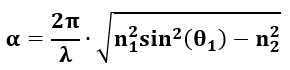
The equation for the attenuation factor, α can be written as,
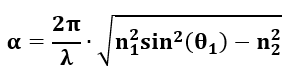
The value of α clearly depends on the refractive indices of the core & the cladding and the incident angle to the optical fiber. The attenuation factor will only have a value if the number under the square root is positive or greater than 0.
i.e,
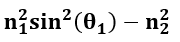
which is displayed as ‘Result 1’ should have a positive value so that the fiber have a valid attenuation factor value for a particular wavelength.
Attenuation Factor
The attenuation factor or attenuation constant (α) of an optical fiber is a parameter used in wave propagation to describe the rate at which the amplitude or intensity of a wave decreases as it travels through a medium. It is often used in fields such as optics, acoustics, and electromagnetic theory.

When light passes through a medium such as glass or a fiber optic cable, its intensity decreases due to various factors such as absorption, scattering, and divergence. The attenuation constant quantifies this decrease in intensity per unit distance traveled through the medium.
According to Beer Lambert’s Law,
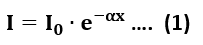
Where:
I is the intensity of light at a distance x into the medium,
I0 is the initial intensity of light entering the medium,
α is the attenuation constant.
Consider a beam of light entering an optical fiber with a core refractive index n1 and cladding refractive index n2. An em wave travels through an optical fiber by total internal reflection (TIR). For TIR to happen, the necessary condition is that n1>n2.
Then using Fresnel's equations and Snell's law, we can express the intensity I as,
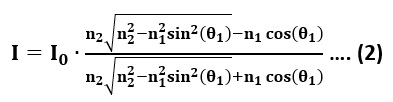
Where:
θ1 is the angle of incidence,
n1 and n2 are the refractive indices of the core and cladding mediums, respectively.
From (1), we can write the equation for α as,
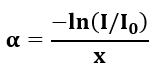
Now substituting the value of I/I0 from (2), we get,
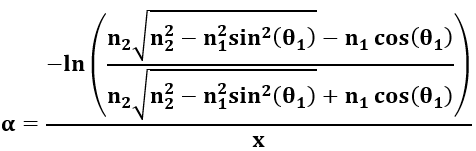
This expression for α can be quite complex and might not have a simple closed-form solution due to the nature of light-matter interactions. However, in some cases or under certain approximations, this expression can be simplified into the form,

Where k0 is the wavenumber in vacuum. Wavenumber can be expressed in terms of wavelength as,

So the equation for the attenuation factor, α can be written as,