Beer-Lambert law gives a relationship between the concentration of a solution and the attenuation of light as it passes through the solution.
The law states that when a beam of monochromatic light is passed through a solution of an absorbing substance then the rate of decrease in intensity of radiation with the thickness of absorbing solution is directly proportional to intensity as well as to the concentration of the solution.

Consider the figure above, a light beam of intensity Io passes through a solution placed in a container of diameter b.
If the solution absorbs light, the intensity of the light emerging from the container will be less than Io. If the intensity of the transmitted light is It, we can define the absorbance A as:
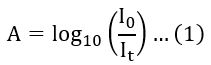
Mathematically, Beer lambert law can be expressed as:
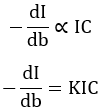
where I is the intensitiy of light at any thickness b, C is the concentration of solution, dI is infinitesimally small decrease in intensity of radiation, db is infinitesimally small decrease in thickness b, and K is the proportionality constant called molar coefficient whose value depends upon the nature of absorbing medium.
On rearrangement of above equation, we get,
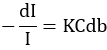
If Io is the intensity of incident radiation when b=0, then the intensity of radiation It after passing through any finite thickness b of the medium can be obtained by integrating the above equation.
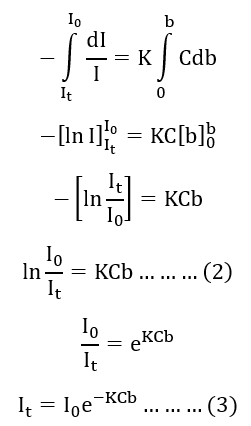
Equation (3) shows that the intensity of a monochromatic beam of light decreases exponentially when the thickness of the medium and intensity increase. Changing natural logarithm to the base 10, equation (2) becomes,
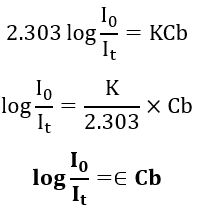
Where, ε = K/2.303, is known as the molar extinction coefficient or molar absorptivity of the absorbing medium. It is expressed in L.mol-1.cm-1. ε is a measure of how strongly a chemical species absorbs light at a given wavelength. It is an intrinsic property of the substance and is used in Beer-Lambert law to relate the concentration of the absorbing species in a solution to the amount of light absorbed.
Now substituting this value in equation (1), we get,
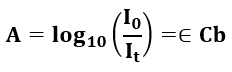
Here It/I0 is known as the transmittance, T and measures how much light passes through a material compared to the amount of light that initially strikes it.
The formula for calculating transmittance (T) can be written as,

T can be expressed in % as,
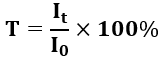
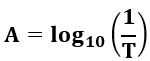
So absorbance, A can be written in terms of transmittance, T as,