Lensmaker's Equation Calculators

This is an online calculator that calculates the focal length and lens power using Lensmaker's Equation. Just enter the radii of curvature of the first and second surface, the refractive index of the lens material and the refractive index of the surrounding medium to get the corresponding focal length and lens power value.

Enter the Radii of Curvature of the First and Second Surface, Refractive Index of Lens Material and the Refractive Index of Surrounding Medium to Calculate the Focal Length and Lens Power Value

  • cm
  • cm

Result

  • Focal Length
    cm
  • Lens Power
    Diopter

Thin lens are those lens whose thickness can be neglected when compared to the lengths of the radii of curvature of its two refracting surfaces, and to the distances of the objects and images from it.

Lens maker’s equation gives the relation between the focal length of the lens, the refractive index of its material, and the radii of curvature of its two surfaces.


Consider a thin convex lens XY with an optical center at C. Let the refractive index of the lens n1 and that of the surrounding medium be n0. The centers of curvature of the two refracting surfaces of the lens be C1 and C2 and let the corresponding radii of curvature be R1 and R2 respectively. Consider a point object O placed on the principle axis of the lens.

A ray of light OA strikes the first surface at A and is refracted in a direction BI1. This ray is further refracted by the second surface in the direction BI and meets the ray which passes undeviated through the principal axis at I. So, the final image is formed at I after the refraction by the two surfaces of the lens.

Considering the refraction at the spherical surfaces we can derive an equation for the image formation. The basic concept is that the image formed by the first refracting surface acts as a virtual object for the second refracting surface. By applying Gauss Formula which is a geometrical method to describe the behaviour of light, we can write,


The first surface XAY forms a real point-image I1. So in the above equation, v can be replaced by v1 and R by R1. Using sign convention, the distances measured to the left of the principal axis is negative. So, here u is negative and the above equation can be rewritten as,


From the figure, the light leaving the first surface would form an image I1 if the second surface was absent. With the second surface, I1 becomes a virtual object for the second surface and it forms an image at I, which is the final image. The equation for the final image formation can be written using Gauss formula. Here we take u =v and R=R2, thus we get,


Applying the sign convention, we get


Adding (1) and (2), and simplifying we get,


If we consider the object at infinity, the image will be formed at the principal focus of the lens. So in the above equation, u=∞ and v=f and can be rewritten as,


This equation is known as the Lens Maker’s Equation for a thin lens in an ambient medium.

Power of a lens is the measure of the ability of a lens to converge or diverge the rays falling on it. It is defined as the inverse of the focal length of a lens. 


The power of lens is expressed in Diopter which is the inverse of its focal length expressed in metres, i.e. diopter = m-1.

This is an online calculator that calculates the focal length and lens power using Lensmaker's Equation. Just enter the radii of curvature of the first and second surface, the refractive index of the lens material and the thickness of the lens to get the corresponding focal length and lens power value.

Enter the Radii of Curvature of the First and Second Surface, Refractive Index of Lens Material and Thickness of the Lens to Calculate the Focal Length and Lens Power Value

  • cm
  • cm
  • cm

Result

  • Focal Length
    cm
  • Lens Power
    Diopter

Thick lens is a physically large lens whose spherical surfaces are separated by a distance. In other words, it is a lens whose thickness cannot be neglected when compared to its focal length.

Lens maker’s equation gives the relation between the focal length of the lens, the refractive index of its material, and the radii of curvature of its two surfaces.


Consider a thick lens with a thickness d as in the figure above. Let a ray AB coming from infinity, parallel to the axis be refracted along BG. This ray emerges at the second surface along GF2. Here H1P1 and H2P2 are the two principal planes. Principal planes are the plane perpendicular to the principal axis of the lens and passing through its focal point. Let R1 and R2 be the radii of curvature of the first and second surface respectively and n be the refractive index of the lens material.

Let us consider that the lens is placed in air so that the first and second focal lengths designated by P1F1 and P2 F2 respectively are equal, and we take it as f.

Let I be the image position formed by the refraction at the first surface BC. So,

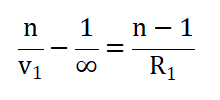
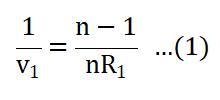
Since u = ∞, by applying the Gauss Formula which is a geometrical method to describe the behaviour of light, we can write,
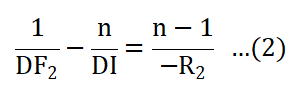
The second surface of the lens refracts the ray along F2 and the final image is formed at F2. So a similar equation for the second surface can be written as,

Here the pairs of triangles, H2P2F2 , GDF2 and BCI, GDI are similar. Therefore,
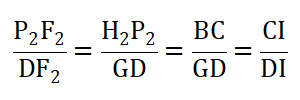

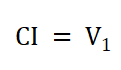
Here P2F2 = f is the focal length and CI = v1. So by rearranging, the above equation becomes, 


Multiplying (2) by DI, we get,


Substituting the above equation in (4), we get,


Here CI = v1 and CD = d is the thickness of the lens. Thus the above equation can be rewritten as,


Using (1) for 1/v1 into the above equation, we get,


This equation is known as the Lens Maker’s equation for a thick lens.

Power of a lens is the measure of the ability of a lens to converge or diverge the rays falling on it. It is defined as the inverse of the focal length of a lens.


The power of lens is expressed in Diopter which is the inverse of its focal length expressed in metres, i.e. diopter = m-1.

This is an online calculator that calculates the focal length and lens power using Lensmaker's Equation. Just enter the radii of curvature of the first and second surface and the refractive index of the lens material to get the corresponding focal length and lens power value.

Enter the Radii of Curvature of the First and Second Surface and the Refractive Index of Lens Material to Calculate the Focal Length and Lens Power Value

  • cm
  • cm

Result

  • Focal Length
    cm
  • Lens Power
    Diopter

Thin lens are those lenses whose thickness can be neglected when compared to the lengths of the radii of curvature of its two refracting surfaces, and to the distances of the objects and images from it.

Lens maker’s equation gives the relation between the focal length of the lens, the refractive index of its material, and the radii of curvature of its two surfaces.


Consider a thick lens with a thickness d as in the figure above. Let a ray AB coming from infinity, parallel to the axis be refracted along BG. This ray emerges at the second surface along GF2. Here H1P1 and H2P2 are the two principal planes. Principal planes are the plane perpendicular to the principal axis of the lens and passing through its focal point. Let R1 and R2 be the radii of curvature of the first and second surface respectively and n be the refractive index of the lens material.

Let us consider that the lens is placed in air so that the first and second focal lengths designated by P1F1 and P2 F2 respectively are equal, and we take it as f.

Let I be the image position formed by the refraction at the first surface BC. So,


Since u = ∞, by applying the Gauss Formula which is a geometrical method to describe the behaviour of light, we can write,


The second surface of the lens refracts the ray along F2 and the final image is formed at F2. So a similar equation for the second surface can be written as,


Here the pairs of triangles, H2P2F2 , GDF2 and BCI, GDI are similar. Therefore,
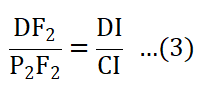

Here P2F2 = f is the focal length and CI = v1. So by rearranging, the above equation becomes,
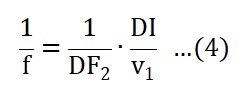

Multiplying (2) by DI, we get,
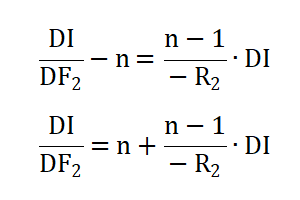

Substituting the above equation in (4), we get,


Here CI = v1 and CD = d is the thickness of the lens. Thus the above equation can be rewritten as,
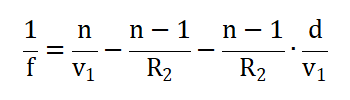

Using (1) for 1/v1 into the above equation, we get,


This equation is known as the Lens Maker’s equation for a thick lens.

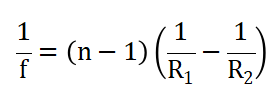
For a thin lens, the thickness, d of the lens can be neglected when compared to the lengths of the radii of curvature of its two refracting surfaces, and to the distances of the objects and images from it. So we can put d = 0 in the above equation. So the Lens Maker’s Equation for a thin lens becomes,
Power of a lens is the measure of the ability of a lens to converge or diverge the rays falling on it. It is defined as the inverse of the focal length of a lens.
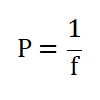

The power of lens is expressed in Diopter which is the inverse of its focal length expressed in metres, i.e. diopter = m-1.