Longitudinal Propagation Factor and Phase Velocity Calculator
This is an online calculator that calculates the Longitudinal Propagation Factor and Phase Velocity of an Optical Fiber. Just enter the Angle of Incidence, Frequency, and Refractive Index of the Core to get the corresponding Longitudinal Propagation Factor and Phase Velocity value.
The longitudinal propagation factor of an electromagnetic (EM) wave refers to a measure of the extent to which the wave propagates in the direction parallel to the oscillation of the electric and magnetic fields.
In typical EM waves, such as light or radio waves, the electric and magnetic fields oscillate perpendicular to the direction of propagation, creating transverse waves. However, in certain materials or under specific conditions, EM waves can exhibit longitudinal propagation, where the electric and magnetic fields oscillate parallel to the direction of propagation.
The longitudinal propagation factor quantifies this behavior, indicating the proportion of the wave's energy that is propagating longitudinally compared to transversely.

Longitudinal Propagation Factor (β): The longitudinal propagation factor (β) represents the rate of change of phase with respect to distance along the fiber axis. It is given by:

where:
- λ is the wavelength of the EM wave in the fiber,
- neff is the effective refractive index of the mode propagating through the fiber.
In the case of an optical fiber, we typically have two media: the core and the cladding. Assuming the fiber is surrounded by air (or vacuum), which has a refractive index close to 1, we can simplify Snell's Law to:

where:
- ncore is the refractive index of the core of the optical fiber,
- θ is the incident angle,
- neff is the effective refractive index of the mode propagating through the fiber.
Now substitute this expression (eqn 3) for neff into the equation for the longitudinal propagation factor (β) (eqn 1):

In terms of frequency, f, given by, f = c/λ, the above equation can be rewritten as,

This equation relates the incident angle (θ) to the longitudinal propagation factor (β) in the context of optical fiber propagation. It is expressed in the unit of rad/m or simply in m-1.
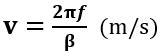
Phase Velocity (v): The phase velocity of an electromagnetic (EM) wave refers to the speed at which a specific phase of the wave, such as a crest or a trough, propagates through a medium. It represents the velocity at which the wavefronts, which are surfaces of constant phase, move through space.
It can be calculated using:

where:
- ω is the angular frequency of the EM wave given by,

is the normal frequency in Hz
Substitute 2.1 in 2,