Prism Angle Calculators

This is an online calculator that calculates the Angle of Prism for a given Refractive Index. Just enter the Angle of Incidence and the Refractive index of the Prism Material to get the corresponding Angle of Prism value.

Enter the Angle of Incidence and Refractive index of the Prism Material to Calculate the Angle of Prism Value

  • deg

Result

  • Prism Angle
    deg


Consider OP is the incidence ray, which is making the angle i1 with normal, and QR is the emergent ray making an angle of emergence, i2 with the normal. A is the prism angle and n is the refractive index of the prism.

The angle of minimum deviation (δ) is the smallest angle of deviation that a prism can produce for a particular wavelength of light. It occurs when the incident ray inside the prism is refracted at the first surface, undergoes minimum deviation inside the prism, and then refracts again at the second surface, emerging parallel to its incident direction.

In the case of minimum deviation, ∠r1=∠r2=∠r

Also, we’ve A = ∠r1 + ∠r2

so, A = ∠r + ∠r = ∠2r

Now, again,

A + δ = i1 + i2  

But in the case of minimum deviation, i1 = i2 = i,

So, A + δ = i + i = 2i  …. (1)


So from snell's law, we have,
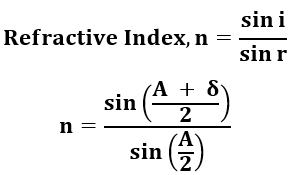
Again from (1), we can write, A + δ = 2i, so the above equation becomes,


This is the equation for the angle of prism, A.

This is an online calculator that calculates the Angle of Prism for a given Angle of Deviation. Just enter the Angle of Incidence, Angle of Emergence, and Angle of Deviation to get the corresponding Angle of Prism value.

Enter the Angle of Incidence, Angle of Emergence, and the Angle of Deviation to Calculate the Angle of Prism Value

  • deg
  • deg
  • deg

Result

  • Prism Angle
    deg

The minimum angle of deviation, δ in a prism occurs when the incident angle is such that the angle of refraction is at its maximum possible value. This typically happens when the incident angle is equal to the angle of minimum deviation.

As seen in the above image, the angle of deviation is represented by δ.

In the △MPQ, by exterior angle theorem, we get,

where i2 = e is the emergent angle or the angle of transmission

In △QNP, ∠QNP + r+ r= 180

Let ∠QNP be equal to θ. Thus, above equation becomes θ + r1 + r2 = 180 … (2)

In quadrilateral APNQ we get,

∠A + 90 + θ + 90 = 360

∠A + θ = 180 … (3)

Combining the equations 2 and 3 we get,

r1 + r2 + (180 – A) = 180

or, r+ r= A

Placing this value in equation 1 we get,

Here i1 = i is the angle of incidence and i2 = e is the angle of emergence. So the angle of prism, A can be calculated as,